Treating a blacklist clear result as clearance of a carrier installment restriction can send a phone into resale before its intended account can use it, creating avoidable returns and rework. When you check an IMEI number, read each finding within the source’s scope and keep the carrier restriction separate from the blacklist response.
What the GSMA strings mean
The GSMA Device Check FAQ gives two responses:
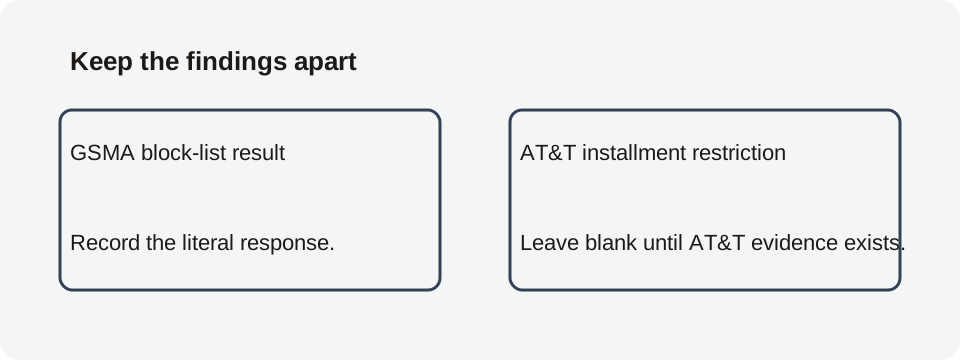
NO - not flagged on GSMA Block List, shown as Green, means the identifier is not currently flagged on that list. It does not establish the absence of an AT&T active installment restriction.YES - flagged on GSMA Block List, shown as Red, identifies a block-list flag. GSMA says this can concern loss, theft or other unsuitability for cellular use; sale or use may be barred. Read the reason in GSMA’s Device History rather than assuming every flag means theft.
GSMA describes network blocking as an operator blocking the identifier on its network. Shared reports may also lead to blocking elsewhere; that does not promise identical enforcement across networks. For a disputed flag, GSMA directs consumers to their wireless provider and commercial or government users to the organization that flagged the device. A seller’s contrary statement does not resolve the recorded flag. GSMA FAQ
The AT&T unpaid-device condition is a separate record
AT&T’s unpaid-device article explains its unpaid device message: the phone is linked to another AT&T Wireless account with an active AT&T Installment Plan and is not authorized for use on a different AT&T Wireless account. That is the named carrier condition to record alongside the GSMA finding.
AT&T says continued use under this condition may lead to blocking on its network and suspension of the service attached to the SIM. Its listed resolution routes include payoff by the original owner and checking whether a transfer of billing responsibility is possible. Those routes do not guarantee a resolution for a particular phone. The article does not establish an automatic GSMA entry. AT&T unpaid-device guidance
The distinction here is an inference from the sources’ separate scopes. It does not assert that every GSMA product lacks financial information. Save the carrier’s evidence and any documented resolution in their own field; do not overwrite them with a blacklist response.
What a blacklist result does not establish
A blacklist response alone does not establish payment completion, carrier unlock eligibility, account-lock state or management release. AT&T’s unlock policy treats payment, lost/stolen/fraud history and account standing as separate criteria. Meeting a payment criterion alone therefore does not establish eligibility.
Keep carrier SIM/network unlock observations in a subfield separate from installment restrictions. AT&T documents Device unlocked in its account view and SIM locked under the iPhone’s Carrier Lock field; these are carrier-unlock displays, not evidence that account or management requirements have been resolved. AT&T unlock policy
The comparison below is an editorial reading aid, not a set of additional provider codes.
| Evidence being read | Scope of the evidence | Dominant Failure Mode | Prevention |
|---|---|---|---|
| GSMA negative block-list response | Current finding on the GSMA list | Treating it as clearance of an installment restriction | Retain a separate carrier-restriction field and its supporting record. |
| GSMA block-list flag | Flag and the returned history | Inferring a reason from the color alone | Preserve the returned reason and seek clarification through the source GSMA identifies. |
| AT&T unpaid-device condition | Use on a different AT&T account while linked to another account’s installment plan | Assuming the blacklist field answers the carrier question | Retain AT&T’s condition and any carrier-documented resolution separately. |
| Carrier-unlock observation | The documented carrier-unlock display | Extending that observation to account or management release | Require evidence for each remaining field. |
How to leave unknown fields unresolved
For each finding, retain the identifier, source, date, coverage statement, literal result and evidence reference. If a report contains only blacklist information, leave the installment, account and management conclusions unresolved. Missing evidence supplies no negative finding. Ask the issuing provider for the definition and coverage of an unfamiliar field before assigning it a meaning.
Use separate account and management subfields even when they share a record group. Give carrier SIM/network unlock observations their own subfield too, so a later update cannot silently replace a different conclusion.
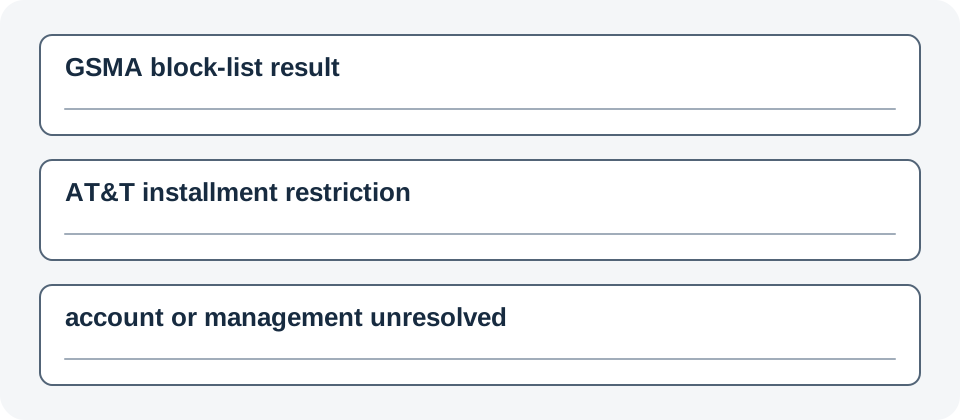
Rule of thumb — a record threshold: if even one required field lacks its own supporting evidence, leave that field unresolved and hold the release decision that depends on it. This is an editorial control, not a carrier acceptance rule.
For the receiving sequence and device-side lock confirmation, use the wholesale phone intake and diagnostic workflow guide.
Sources
- GSMA Device Check FAQs — literal block-list responses, history and disputed-flag guidance.
- AT&T: Get info about unpaid device messages — the other-account installment condition and possible consequences.
- AT&T: Learn how to unlock phones or devices — separate eligibility criteria and carrier-unlock displays.
Sources
- Device Check FAQs — GSMA Accessed October 19, 2026.
- Get info about unpaid device messages — AT&T Accessed October 19, 2026.
- Learn how to unlock AT&T phones or devices — AT&T Accessed October 19, 2026.