Treating “unlocked” or the marketing name as the radio specification can turn a purchase of wholesale unlocked phones into costly returns, repeat checking and delayed resale when the model’s published bands do not meet the agreed destination requirement. Read the exact model identifier, select its manufacturer’s band list and compare it with a written requirement for one destination before accepting that part of the purchase specification.
Where to read the model identifier
On an iPhone, open Settings > General > About. Apple’s model-number instructions explain that the field labeled Model Number initially shows a part number; tap it to reveal the model number. Record the revealed code rather than interpreting the part number as a radio specification.
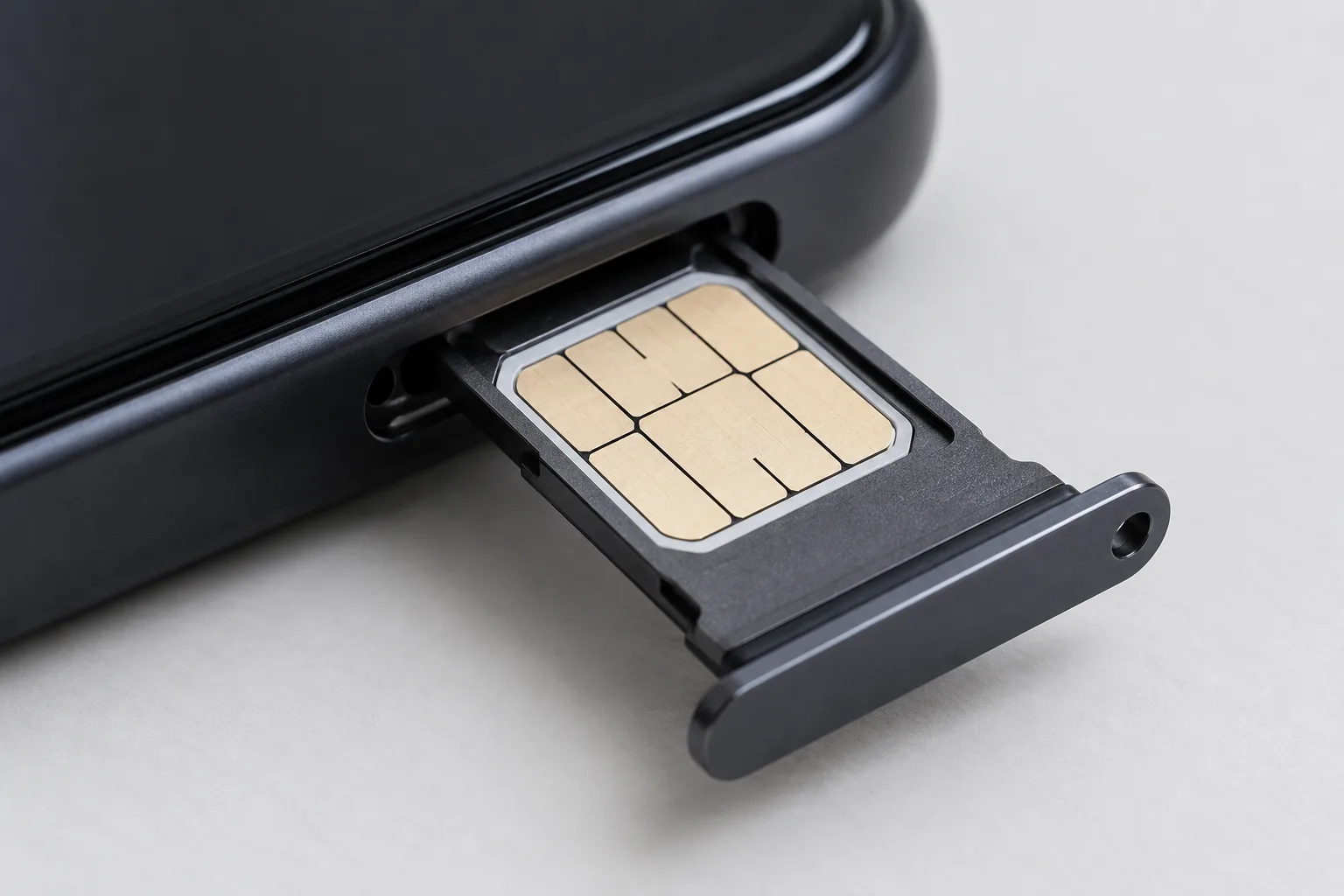
For a printed identifier, Apple describes looking inside the SIM slot on models with a SIM tray. On an iPhone without a SIM tray, look inside the USB-C or Lightning connector. Use the location applicable to the device and retain a readable photo reference alongside the observed code. A lot description saying only “iPhone 16” leaves the regional model unresolved.
Keep the carrier-lock observation in a separate field. Apple’s unlock guidance identifies an unlocked iPhone by the “No SIM restrictions” display beside Carrier Lock in General > About. That display answers the carrier-lock question; the model-specific publication supplies the band list.
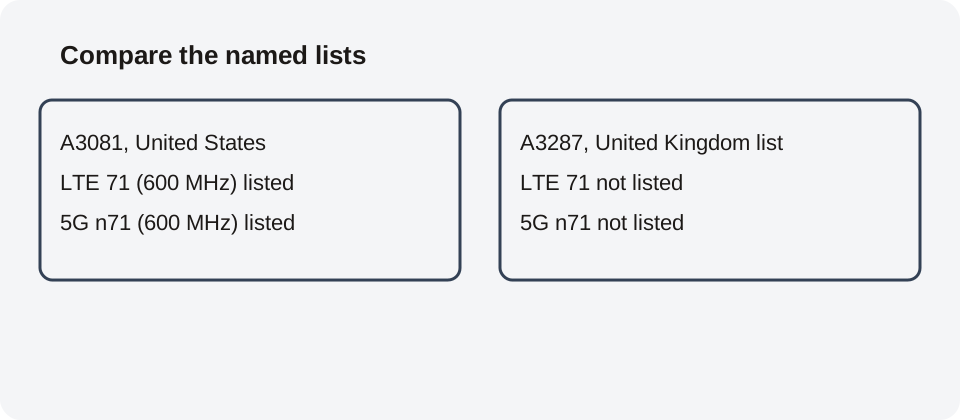
United States example: iPhone 16 A3081
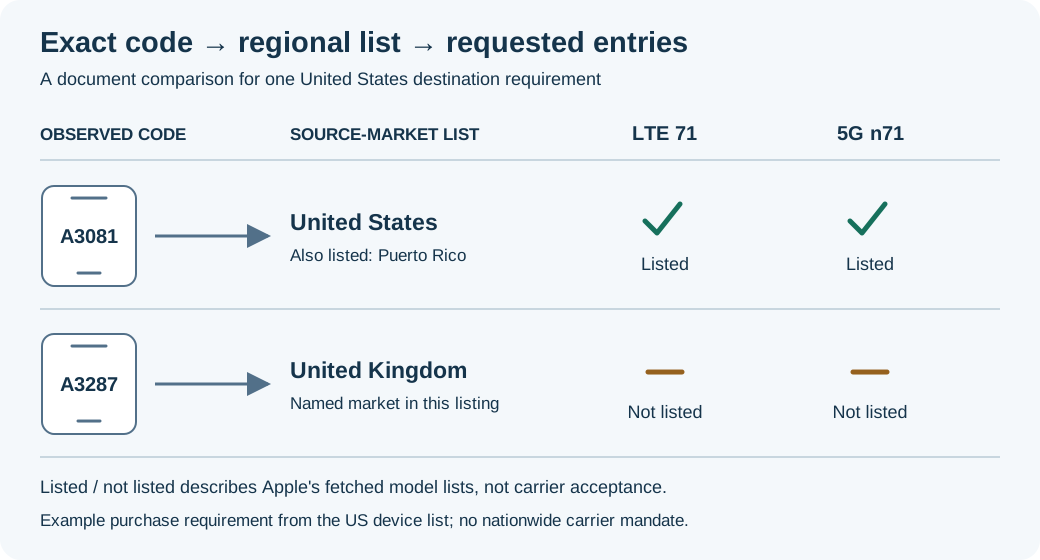
Apple’s model-identification page assigns A3081 to United States and Puerto Rico. Use United States as the destination for this worked comparison; the regional listing does not establish where a particular shipment originated.
For the example purchase condition, take LTE 71 (600 MHz) and 5G n71 (600 MHz) from Apple’s United States A3081 device list. Both entries appear in the corresponding technology lists on Apple’s cellular page. This is an example requirement taken from the US device list, not a nationwide carrier mandate or a verified minimum for every US network.
If the observed code is A3081, record a published-list match for those two requested entries. Preserve the technology labels even though the printed frequency is the same: an LTE entry does not substitute for a 5G entry in the comparison.
United Kingdom-listed A3287 comparison
Apple’s cellular page separately lists iPhone 16 A3287, with United Kingdom among its named markets. The fetched A3287 lists do not include LTE 71 or 5G n71, the two entries requested in the United States example. Record “requested entries not listed” and resolve that requirement before accepting the model against it. This observation does not establish that A3287 cannot obtain service in the United States.
The table compares the same example requirement against the two model rows captured on October 19, 2026; it is not a complete band inventory.
| Observed code and source-market listing | LTE 71 requirement | 5G n71 requirement | Dominant Failure Mode | Prevention |
|---|---|---|---|---|
| A3081 — United States; also listed for Puerto Rico | Listed | Listed | Extending a document match into a carrier-service promise | Record the list match separately and obtain destination-carrier confirmation. |
| A3287 — United Kingdom listing | Not listed in the fetched row | Not listed in the fetched row | Assuming the shared iPhone 16 name supplies the US example entries | Compare the exact code’s lists and leave the unmet requirement unresolved. |
What a band-list match does not establish
Apple states that service availability depends on the market and carrier and that speeds vary with site conditions and carrier. Its cellular guidance makes use outside the purchase country conditional on a valid SIM from a supported carrier and directs readers to the carrier for details. A matching list therefore leaves carrier acceptance, activation and local performance unconfirmed. It also supplies no observation of a particular handset’s condition or lock display.
For each comparison, retain the observed code and photo reference; manufacturer URL and access date; source-market label; one destination country and intended carrier if known; required technology-specific entries and where that requirement came from; and a separate result for each entry. Use listed, not listed or unknown. If the exact code or its source cannot be established, use unknown rather than treating missing evidence as a missing capability. Keep carrier confirmation and the resulting decision in separate fields.
Rule of thumb — record threshold: if even one required entry is not listed or remains unknown, hold acceptance against that band requirement until it is resolved; if every entry is listed, record only a published-list match and retain the separate carrier check. This is an editorial record control, not an Apple acceptance standard.
Use the wholesale phone intake and diagnostic workflow guide for the receiving sequence and device-side checks. This comparison adds a destination-band decision to that record. Related guides sit in the wholesale category.
Sources
- Apple: Find the model number — Settings steps and physical identifier locations.
- Apple: Identify your iPhone model — the iPhone 16 A3081 regional assignment.
- Apple: Supported 5G and LTE networks — A3081 and United Kingdom-listed A3287 lists, plus market and carrier qualifications.
- Apple: Unlock your iPhone — the separate Carrier Lock display.
The comparison uses the public pages captured on October 19, 2026. The suggested record fields and threshold are editorial recommendations derived from their separate scopes.
Sources
- Find the model number of your iPhone, iPad, or iPod touch — Apple Accessed October 19, 2026.
- Identify your iPhone model — Apple Accessed October 19, 2026.
- iPhone: Supported 5G and LTE networks — Apple Accessed October 19, 2026.
- How to unlock your iPhone for use with a different carrier — Apple Accessed October 19, 2026.