Direct answer
When grading bulk used phones, separate genuine OEM pull Soft OLED displays from cold-pressed refurbished glass, aftermarket Soft or Hard OLEDs, and Incell LCD replacements before releasing Grade A stock. Use component records, diagnostic results and model-specific physical inspection to check the contracted display specification.
Key takeaways
- Never rely on iOS Parts and Service History alone when grading bulk used phones; transplanted OEM touch ICs (MtSN swaps) hide aftermarket screens from software alerts.
- Classify every handset screen into one of five supply tiers: Genuine OEM Pull, FOG Cold-Pressed Refurb Glass, Aftermarket Soft OLED, Aftermarket Hard OLED, or Incell TFT-LCD.
- Rotate a linear polarizer test filter through 45° and 90° to spot Incell LCD total blackout and cold-pressed OCA photoelastic rainbow stress halos.
- Audit bottom chin bezels and frame sit: rigid Hard OLEDs and Incell LCDs add +1.2 mm to +2.0 mm to the bottom chin and sit +0.25 mm to +0.75 mm proud of the housing.
- Verify 120 Hz LTPO ProMotion dynamic scaling (8.33 ms frame time) and 105°–115° deionized water droplet contact angles to catch 60 Hz-locked panels and cerium-oxide buffed glass.
- Deduct full OEM screen replacement value ($85–$160/unit) or file an immediate supplier RMA whenever Hard OLED or LCD swaps appear in lots sold as Grade A Original.
Receiving a shipment of bulk used phones invoiced as “Grade A / A+ 100% Original OEM” and discovering after the supplier claim window closes that 15% to 25% of the lot carries disguised $18 to $35 aftermarket Hard OLEDs, backlit Incell TFT-LCDs, or cerium-oxide buffed glass creates an immediate $85 to $160 per-unit margin loss. Wholesale buyers and QC benches must separate genuine OEM pull Soft OLED displays from cold-pressed refurbished glass, aftermarket Soft or Hard OLEDs, and Incell LCD replacements by combining EEPROM serial audits with 90-second optical and mechanical tests before accepting them against the agreed component and functional requirements.
Automated multi-port USB intake suites (Phonecheck, NSYS, 3uTools) and iOS Settings > General > About checks no longer catch every replaced screen on their own. Secondary refurbishment brokers routinely grind down shattered OEM displays, desolder the original encrypted touch controller IC (MtSN EEPROM), and solder it onto an aftermarket Soft OLED, Hard OLED, or Incell LCD flex cable so software reports a 100% Factory Serial Match with zero "Unknown Part" alert. Integrating a 90-second optical, mechanical, refresh-rate, and surface-energy screening protocol into our wholesale phone intake and diagnostic workflow guide, paired with automated touch-grid and digitizer testing across our wholesale phone sourcing and grading operations, exposes every disguised panel before an invoice is cleared.
| Display Supply Tier | Substrate & Touch IC Architecture | Bottom Chin Bezel & Z-Height Sit | 90° Polarizer & #000000 Black Check |
Refresh Rate & Water Contact Angle (θ_C) |
Wholesale Grade Disposition & Price Impact |
|---|---|---|---|---|---|
| Tier 1: Genuine OEM Original / Clean OEM Pull | Flexible polyimide (PI) LTPO/LTPS Soft OLED + factory MtSN touch IC + Ceramic Shield / Gorilla Glass Victus |
2.0–2.5 mm (1.15–1.55 mm BRS on 15/16 Pro); 0.00 mm (±0.05 mm) flush sit |
Uniform neutral ~50% transmission (0°–360°); 0.000 cd/m² pure black |
Full 10–120 Hz / 1–120 Hz LTPO (8.33 ms); PVD bead 105°–115° |
Grade A / A+ OEM Original ($0 deduction; -3% to -7% if iOS 18 Used badge) |
Tier 2: FOG / Glass-Only Refurbished (Cold-Pressed OCA) |
Genuine OEM flexible PI AMOLED + original MtSN IC laminated to aftermarket glass via -150°C separation |
2.0–2.5 mm (identical OEM active area); +0.05 to +0.18 mm slight OCA stand-off | No 90° blackout; 45° angle reveals rainbow photoelastic stress halos |
Full 120 Hz LTPO (8.33 ms) preserved; spray coating 65°–88° |
Grade A- / B+ Refurbished OEM Panel (-$15 to -$30/unit; must disclose reglassing) |
Tier 3: Aftermarket Soft OLED (GX / ZY / JK High-Tier) |
Third-party flexible PI AMOLED with 180° COP/COF fold; 3rd-party IC or transplanted OEM MtSN IC |
2.2–2.7 mm (+0.2 to +0.3 mm vs. OEM); +0.10 to +0.25 mm sit |
Slight magenta/green tint shift at 45°–90°; 0.000 cd/m² black |
Fixed 60 Hz (16.67 ms) or non-LTPO 80–120 Hz (no 1 Hz idle); 75°–92° |
Downgrade to Grade C / Aftermarket Functional (-$55 to -$95/unit deduction) |
Tier 4: Aftermarket Hard OLED (Rigid Glass Substrate) |
Rigid dual-glass AMOLED unable to fold bottom COG/COF ledge; -0.1" to -0.2" smaller active diagonal |
3.8–4.6 mm (+1.2 to +2.0 mm thick chin + tight corners); +0.25 to +0.45 mm proud |
Deep purple or amber darkening at 60°–90°; 0.000 cd/m² black |
Locked at 60 Hz (16.67 ms) on ProMotion models; weak coating 55°–75° |
Immediate Supplier RMA / Screen Reject (-$85 to -$140/unit; high internal crack risk) |
Tier 5: Aftermarket Incell / COG TFT-LCD (Backlit Swap) |
Transmissive LTPS TFT-LCD + LED edge backlight + light guide plate + crossed linear polarizers | 4.0–5.2 mm (thickest bottom chin + truncated corners); +0.45 to +0.75 mm step | 100% pitch-black extinction at 90°; leaks 0.35–0.85 cd/m² blue-gray on #000000 |
Locked 60 Hz with 18–28 ms LC smear; uncoated glass < 65° puddle |
Mandatory Quarantine & Chargeback (-$95 to -$160/unit + board rail check) |
The 5-Tier Display Supply Chain in Bulk Used Phones
Evaluating oem vs aftermarket display grading across secondary wholesale auctions and trade-in aggregators requires classifying every handset screen into one of five distinct hardware manufacturing tiers. Treating all screens that boot without an iOS warning as “OEM Grade A” ignores fundamental structural differences in substrate flexibility, optical polarization, power draw, and drop survivability. When reviewing supplier manifests alongside how graded used phones are described, receiving managers must separate cosmetic top-glass grades (Grade A / B / C) from the underlying display stack.
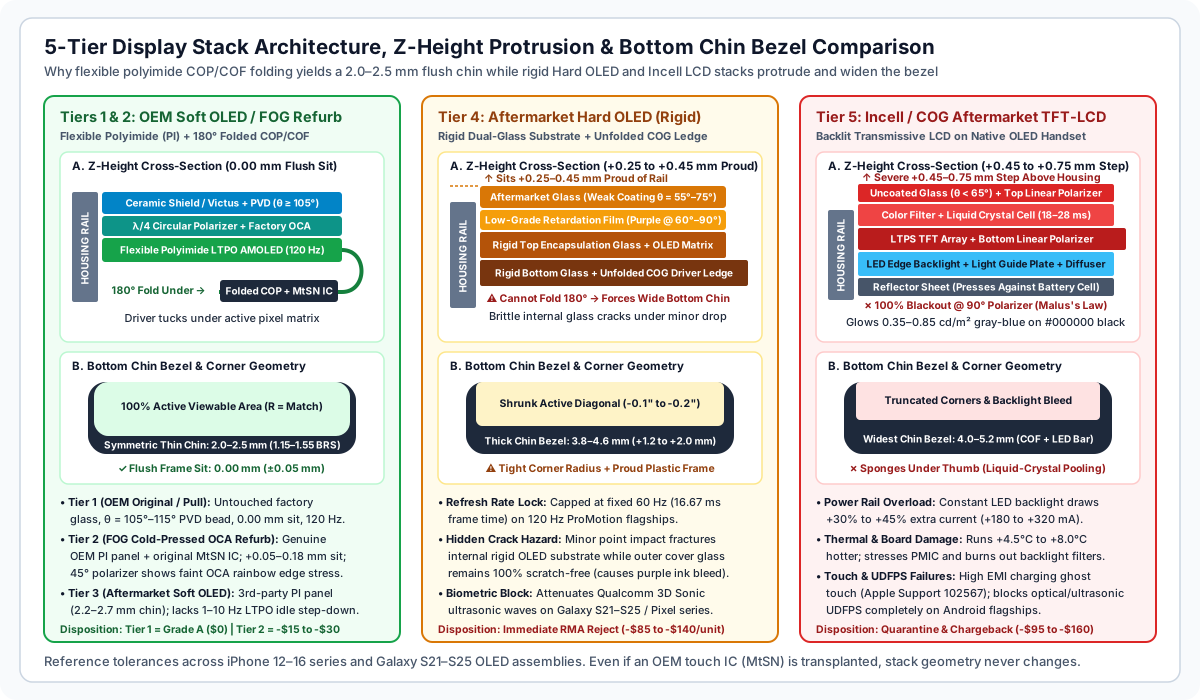
1. Tier 1: Genuine OEM Original, Service Pack, and Clean OEM Pull (Soft OLED)
Genuine flagship displays on iPhone X through 16 series, Samsung Galaxy S21 through S25 series, and Google Pixel 6 through 10 Pro models are engineered around a flexible polyimide (PI) plastic substrate driven by a low-temperature polycrystalline oxide (LTPO) or low-temperature polycrystalline silicon (LTPS) thin-film transistor backplane, as detailed in Apple Support 103256 on genuine iPhone displays.
Because the polyimide substrate is flexible like photographic film rather than brittle like window glass, OEM factories execute a 180° Chip-on-Plastic (COP) or Chip-on-Film (COF) bend at the bottom margin of the panel. Folding the display driver flex and touch controller ledge completely underneath the active pixel matrix eliminates the dead bottom border, yielding a symmetric 2.0 to 2.5 mm bottom chin bezel (1.15 to 1.55 mm on iPhone 15 Pro and 16 Pro models utilizing Border Reduction Structure BRS routing). Tier 1 assemblies sit 0.00 mm (±0.05 mm) flush with the chamfered titanium or aluminum housing rail, retain factory Ceramic Shield or Gorilla Glass Victus cover glass with a physical vapor deposition (PVD) fluoropolymer coating, and carry their original factory-paired MtSN touch IC.
2. Tier 2: FOG / Glass-Only Refurbished (OEM Panel + Cold-Pressed OCA Glass)
A Flex-on-Glass (FOG) or Refurbished Glass display starts as a damaged Tier 1 OEM assembly where the organic AMOLED pixel matrix and touch digitizer remain 100% functional, but the outer cover glass is deeply scratched or cracked. Specialized refurbishment lines salvage the expensive OEM Soft OLED core through a four-stage industrial process:
- Cryogenic Freezing (
-150°Cto-180°C): The screen is placed on an ultra-low-temperature freeze plate that embrittles the factory optically clear adhesive (OCA) without damaging the flexible polyimide AMOLED layer. - Molybdenum Wire Separation: A
0.03 mmheated or tensioned wire slices between the shattered Ceramic Shield glass and the polarizer film, followed by solvent removal of residual OCA. - Cold-Pressed OCA Vacuum Lamination: A replacement third-party aluminosilicate glass lens (pre-mounted with a plastic mid-frame bezel) is aligned over the original OEM panel and compressed inside a vacuum autoclave to eliminate air pockets.
- Secondary Coating: An atmospheric spray or wipe-on hydrophobic liquid is applied to simulate the factory oleophobic finish.
In bulk used phones, Tier 2 FOG screens preserve 100% genuine OEM pixel density (458–460 PPI), peak HDR luminance, 120 Hz LTPO refresh scaling, and original MtSN serial pairing. However, thicker aftermarket OCA sheets and re-glued plastic frames typically raise the glass +0.05 to +0.18 mm above the housing lip, leave faint rainbow stress patterns under 45° polarized light, and use thinner oleophobic coatings that wear off within 30 to 60 days. A related sub-tier is CNC cerium-oxide polished glass, where wholesalers grind 20 to 40 µm of glass off a scratched OEM screen on a wet cerium-oxide buffing wheel to pass it off as untouched Grade A—stripping the factory PVD oleophobic layer completely.
3. Tier 3: Aftermarket Soft OLED (Flexible Polyimide — GX, ZY, JK, RJ High-Tier)
Higher-end third-party factories manufacture aftermarket Soft OLED assemblies on flexible polyimide substrates that copy the OEM 180° bottom fold. As a result, a Tier 3 Aftermarket Soft OLED achieves a 2.2 to 2.7 mm bottom chin bezel—within +0.2 to +0.3 mm of a genuine OEM panel—and survives drops far better than rigid glass screens.
Despite passing casual visual inspection, Tier 3 panels differ from Tier 1 OEM screens in four ways:
- Peak Luminance & Color Gamut: Sustained high-brightness mode typically plateaus at
650 to 850 nitscompared to1,000 to 2,000 nitson genuine Apple Super Retina XDR and Samsung Dynamic AMOLED 2X panels, with a noticeable green or magenta white-point shift at30°off-axis viewing angles. - Missing LTPO Oxide Step-Down: On ProMotion models (
iPhone 13 Prothrough16 Pro), many aftermarket Soft OLEDs either cap refresh timing at60 Hzor run fixed80–120 HzLTPS clocks that cannot dynamically step down to10 Hzor1 Hzduring static Always-On display states, increasing idle battery drain. - Transplanted IC Rework Signatures: To hide the swap in
Settings, refurbishers frequently solder the original OEMMtSNchip onto a piggyback flex tail covered by spot-welded silver EMI tape.
4. Tier 4: Aftermarket Hard OLED (Rigid Dual-Glass Substrate)
Aftermarket Hard OLED screens substitute two rigid glass layers (a bottom LTPS TFT glass substrate and a top encapsulation glass plate) in place of flexible polyimide. Because rigid glass shatters if bent, the manufacturer cannot fold the bottom Chip-on-Glass (COG) driver ledge underneath the display.
Instead, the driver circuits must sit flat along the bottom margin of the front glass. This architectural limitation creates three unmistakable defects in bulk used phones:
- Thick Bottom Chin & Shrunk Viewable Window: The bottom black bezel widens by
+1.2 mm to +2.0 mm(measuring3.8 to 4.6 mmtotal), pushing the active display window upward, shrinking the diagonal viewable size by0.1" to 0.2", and forcing tighter corner radii that fail to follow the outer curve of the phone’s housing. - Proud Z-Height Stand-Off: The rigid glass stack sits
+0.25 to +0.45 mmproud of the metal chassis rail, catching a fingernail or feeler gauge along the perimeter. - Catastrophic Internal Glass Fracture: Because the internal OLED layer is rigid glass, a minor drop, back-pocket flex, or firm thumb press frequently cracks the fragile internal OLED substrate while leaving the thicker outer Gorilla Glass 100% unscratched—producing purple ink-bleed, neon green vertical lines, or an instant black screen days after wholesale purchase.
5. Tier 5: Aftermarket Incell / COG TFT-LCD Installed on Native OLED Handsets
The most destructive substitution in secondary phone lots is installing a transmissive $15 to $22 Incell or COG TFT-LCD onto an iPhone (X through 16 series) or Android flagship engineered exclusively for self-emissive OLED.
Unlike an OLED panel where each organic subpixel generates its own light and draws zero current on #000000 black, a TFT-LCD requires a continuous high-voltage LED edge backlight, a plastic light guide plate, optical diffuser films, a liquid-crystal cell, and two crossed linear polarizers:
- Electrical Overload (
+30% to +45%Extra Current): Driving a constant full-area LED backlight through display power rails designed for variable-duty OLED pixel currents pulls+180 to +320 mAof excess current, elevates chassis temperatures by+4.5°C to +8.0°C, and routinely burns out the motherboard’s backlight boost coil or PMIC display filters. - Severe Mechanical Protrusion (
+0.45 to +0.75 mm): The multi-layer backlight stack forces the glass+0.45 to +0.75 mmabove the housing bezel, while the bottom COF/LED bar expands the chin bezel to4.0 to 5.2 mm. Internally, the thicker backlight housing presses directly against the lithium-ion battery cell. - Biometric & Touch Breakdown: As documented in Apple Support 102567 on unresponsive and ghost-touch screens, poorly shielded Incell LCDs suffer severe capacitive ghost touch when plugged into high-frequency USB-C PD chargers. On Android flagships, the opaque backlight reflector sheet and thick glass completely block optical and Qualcomm 3D Sonic ultrasonic under-display fingerprint sensors (Google Pixel Help 14257407; Samsung Support ANS10001613).
Takeaway: Record cosmetic condition, display provenance and functional test results separately. A scratch-free handset with a replacement display may meet a defined cosmetic grade while failing an order that specifies original components. Confirm touch response, brightness, power behavior and mechanical fit against the agreed acceptance specification.
Step-by-Step 90-Second Bench Inspection Protocol to Detect Aftermarket Screens
Equip every receiving bench with four low-cost physical tools—a calibrated linear polarizer filter card (or non-mirrored linearly polarized test glasses), a digital caliper with a depth/step blade, a 120 Hz scroll test chart, and a 5 µL precision micropipette filled with deionized water—to detect aftermarket screen used phone swaps in under 90 seconds without turning a single pentalobe screw.
Step 1: Linear Polarizer Rotation (0°, 45°, 90°) and Dark-Room #000000 Check (0–25 Seconds)
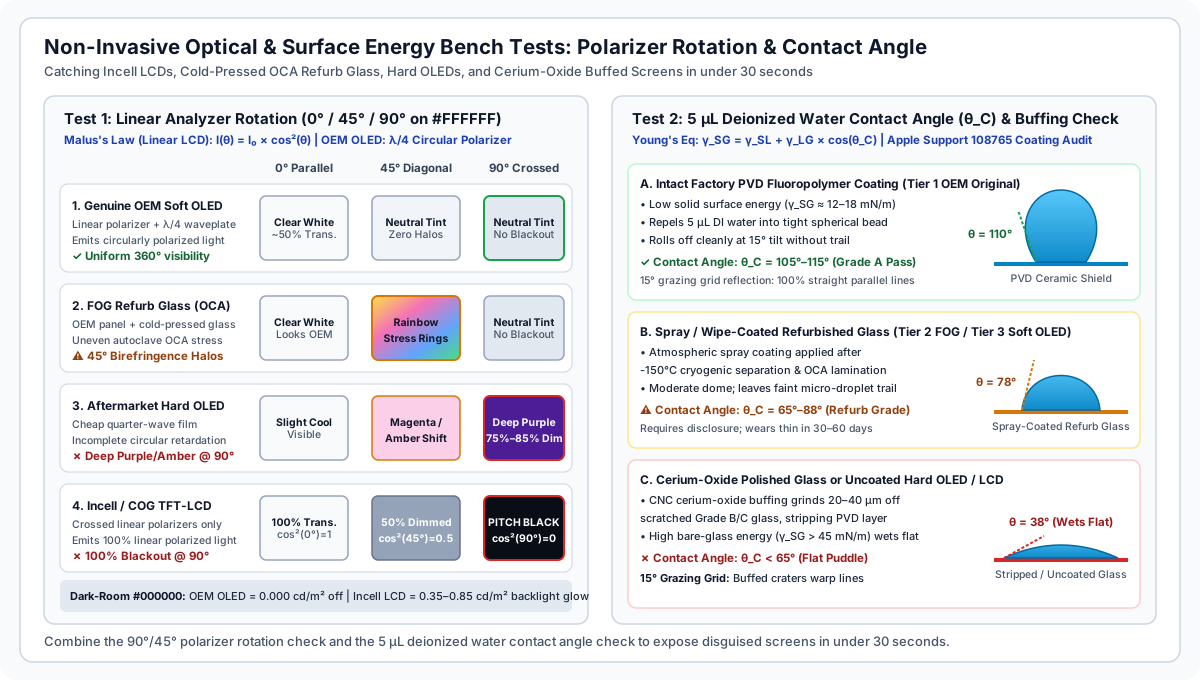
Set the handset screen to 100% brightness on a pure white (#FFFFFF) background, hold a linear polarizer analyzer filter in front of the glass, and rotate the filter slowly from 0° (vertical) through 45° (diagonal) to 90° (horizontal). The optical response immediately separates LCDs, cold-pressed OCA glass, Hard OLEDs, and genuine OEM Soft OLEDs:
- Incell TFT-LCD (
100% Blackout at 90°via Malus’s Law): A TFT-LCD sandwiches its liquid-crystal layer between two linear polarizers, meaning the light exiting the screen is 100% linearly polarized along a fixed axis. When viewed through an external linear polarizer rotated by angleθrelative to the screen’s transmission axis, transmitted light intensity obeys Malus’s Law:I(θ) = I_0 × cos²(θ)Atθ = 0°,cos²(0°) = 1(full brightness). Atθ = 45°,cos²(45°) = 0.50(50% dimmed). Atθ = 90°,cos²(90°) = 0—the screen undergoes 100% optical extinction and turns completely pitch black. - Genuine OEM Soft OLED (
Uniform Neutral Visibility Across 0°–360°): Genuine Apple and Samsung OLED displays laminate a linear polarizer to a quarter-wave (λ/4) retardation plate oriented at45°, creating a circular polarizer that traps ambient light reflections inside the panel so the screen remains readable in bright sunlight. Because theλ/4waveplate converts outbound pixel light into circularly polarized light with equal electric field components in all directions, rotating a linear analyzer from0°to90°and360°maintains a constant, neutral~50%transmission with zero blackout and zero color banding. - Tier 2 FOG Cold-Pressed OCA Refurbished Glass (
45° Rainbow Stress Halos): Because a FOG screen retains the genuine OEM panel underneath, it does not black out at90°. However, cold-pressing an aftermarket cover glass onto the panel with an OCA sheet inside an autoclave introduces residual mechanical strain (Δσ) in the adhesive and glass. At a45°polarizer rotation angle, this mechanical strain induces photoelastic birefringence—splitting polarized white light into unmistakable iridescent rainbow oil-slick rings and stress halos around the bezel edges and Dynamic Island or notch cutout. - Tier 4 Aftermarket Hard OLED (
Deep Purple / Amber Shift at 60°–90°): Low-cost Hard OLEDs use inexpensive polymer retardation films whose phase delay deviates from a true quarter-wave (λ/4) across the visible spectrum. Rotating the analyzer between60°and90°causes the display to shift deep violet-purple, magenta, or dark amber, losing75% to 85%of its luminance. - Dark-Room
#000000Backlight Bleed Confirmation: Switch the test image to pure#000000black inside a shaded hood. Every OLED tier (Tiers 1–4) switches off individual pixel current completely (0.000 cd/m²pitch black), whereas a Tier 5 Incell LCD glows with0.35 to 0.85 cd/m²of bluish-gray backlight leakage along the bottom COF edge and corners.
Step 2: Bottom Chin Bezel and Z-Height Frame Stand-Off Micrometer Audit (25–50 Seconds)
With the white #FFFFFF test screen still active, inspect the inactive black border around the perimeter and measure the bottom chin bezel and housing rail step:
- Bottom Chin vs. Side Bezel Symmetry (
2.0–2.5 mmvs.3.8–5.2 mm): On every modern all-screen OLED smartphone (iPhone X through 16 series, Galaxy S21 through S25), the genuine OEM bottom black bezel matches the left and right side bezels, measuring2.0 to 2.5 mm(1.15 to 1.55 mmon iPhone 15 Pro and 16 Pro). If the bottom black chin is visibly wider than the side bezels—measuring3.8 to 4.6 mmon a caliper—the unit has a Tier 4 Aftermarket Hard OLED. If the chin measures4.0 to 5.2 mmwith squared-off bottom display corners, it is a Tier 5 Incell LCD. - Z-Height Housing Stand-Off (
0.00 mmFlush vs.+0.25 to +0.75 mmProud): Run a fingernail or the step-depth face of a digital caliper across the junction where the outer aluminum or titanium mid-frame meets the front cover glass:- Tier 1 OEM Original: Sits
0.00 mm (±0.05 mm)flush or micro-recessed below the metal chamfer so a side impact hits the metal frame first. - Tier 2 FOG Refurbished Glass: Often sits
+0.05 to +0.18 mmhigher due to thicker175–250 µmaftermarket OCA sheets or re-bonded bezel frames. - Tier 4 Hard OLED & Tier 5 Incell LCD: Protrude
+0.25 to +0.45 mm(Hard OLED) and+0.45 to +0.75 mm(Incell LCD) proud of the metal rail, exposing the unshielded glass edge to immediate chipping.
- Tier 1 OEM Original: Sits
Step 3: LTPO ProMotion 120 Hz (8.33 ms) Frame Pacing and Digitizer Sweep (50–70 Seconds)
On high-refresh flagships—including iPhone 13 Pro, 14 Pro, 15 Pro, and 16 Pro (ProMotion) and Samsung Galaxy S21 through S25 series—verify that the display backplane actually delivers 120 Hz frame pacing rather than running a 60 Hz-locked aftermarket panel.
As documented in Apple Developer documentation on optimizing ProMotion refresh rates, frame persistence time (T_frame) is inversely proportional to refresh frequency (f_refresh):
T_frame (ms) = 1,000 ÷ f_refresh (Hz)
- Genuine OEM LTPO Soft OLED (
8.33 msFrame Interval): Dynamically scales across discrete refresh steps—120 Hz(8.33 ms),80 Hz(12.5 ms),60 Hz(16.67 ms),48 Hz(20.83 ms),30 Hz(33.33 ms),24 Hz(41.67 ms),16 Hz(62.5 ms),12 Hz(83.33 ms), and10 Hz(100 ms) (stepping down to1 Hz/1,000 mson Always-On displays). During a fast vertical scroll ofSettingsor a UFO frame-rate counter, text edges remain razor-sharp at8.33 mspersistence. - Aftermarket Hard OLED & Budget Soft OLED (
16.67 msLock): Lacking an LTPO oxide transistor gate driver, aftermarket replacements lock refresh timing at60 Hz(16.67 msper frame)—doubling motion blur persistence (+100%frame hold time) and causing visible judder when flicking lists side-by-side against a known-good OEM reference unit. - Digitizer Sampling & Charging EMI Check: Genuine OEM digitizers sample touch input at
120 to 240 Hz(4.17 to 8.33 ms). Aftermarket panels frequently drop touch reporting to60 to 90 Hz(11.1 to 16.7 ms), causing missed fast-typing keystrokes and broken perimeter swipes. Always run a physical perimeter and multi-touch trace using our automated touch-grid and digitizer testing guide while the handset is connected to a20W+USB-C PD charger to expose EMI-induced ghost touches (Apple Support 102567).
Step 4: Oleophobic Coating Deionized Water Contact Angle (θ_C) and Polishing Check (70–90 Seconds)
To catch CNC cerium-oxide buffed screens (scratched Grade B/C OEM screens mechanically ground down to mimic untouched Grade A stock) as well as uncoated aftermarket glass, test the surface energy of the front glass under Apple Support 108765 oleophobic coating guidelines.
Under Young’s Equation, the static contact angle (θ_C) of a liquid droplet resting on a solid flat surface is governed by the balance between solid-gas surface energy (γ_SG), solid-liquid interfacial tension (γ_SL), and liquid-gas surface tension (γ_LG):
γ_SG = γ_SL + γ_LG × cos(θ_C)
Dispense a 5 µL droplet of deionized water (γ_LG = 72.8 mN/m at 20°C) onto the center swipe zone of a degreased screen and observe the bead profile at eye level:
- Intact Factory PVD Fluoropolymer (
θ_C = 105° to 115°): OEM Ceramic Shield and Gorilla Glass undergo vacuum physical vapor deposition (PVD) of perfluoropolyether, lowering solid surface energy toγ_SG ≈ 12–18 mN/m. Becauseγ_SG < γ_LG,cos(θ_C)is negative (θ_C > 90°), forcing the water droplet into a high, tight spherical bead (105° to 115°) that rolls off cleanly when the phone is tilted15°. - Spray-Coated Tier 2 FOG Refurb / Tier 3 Soft OLED (
θ_C = 65° to 88°): Post-lamination spray or wipe coatings form a weaker hemisphere bead that drags slightly when wiped. - Cerium-Oxide Buffed “Fake Grade A” or Uncoated Hard OLED / LCD (
θ_C < 65°): Abrasive cerium-oxide polishing grinds away20 to 40 µmof glass and strips the PVD fluoropolymer layer completely, exposing bare aluminosilicate glass (γ_SG > 45 mN/m). The5 µLdroplet collapses immediately into a flat wetting puddle (θ_C = 30° to 60°). Confirm mechanical buffing in 5 seconds by reflecting an overhead straight fluorescent light tube or grid across the unlit glass at a15°grazing angle: cerium-oxide polishing leaves concave trough craters that warp the straight tube reflection like a funhouse mirror.
| Bench Test Step & Target Time | Tool / Setup Required | Genuine OEM Pull / Service Pack Pass (Tier 1) |
FOG Cold-Pressed Refurb Glass Signature (Tier 2) |
Aftermarket Hard OLED / Incell LCD Fail (Tiers 4–5) |
|---|---|---|---|---|
1. Linear Analyzer Rotation (0–15s) |
Linear polarizer filter card on #FFFFFF 100% white |
Uniform neutral ~50% tint across 0°–360°; zero blackout |
No 90° blackout, but rainbow stress halos at 45° |
Incell LCD = 100% pitch black at 90°; Hard OLED = deep purple/amber at 60°–90° |
2. Dark-Room #000000 Check (15–25s) |
Shaded lightbox + pure #000000 full-screen black |
0.000 cd/m² total pixel shutoff (infinite contrast) |
0.000 cd/m² total pixel shutoff (check for dust specks) |
Incell LCD leaks 0.35–0.85 cd/m² bluish-gray backlight glow at edges |
3. Chin Bezel & Z-Height Audit (25–50s) |
Digital caliper (0.01 mm resolution) + feeler gauge |
2.0–2.5 mm symmetric chin (1.15–1.55 mm BRS); 0.00 mm flush sit |
2.0–2.5 mm chin; +0.05 to +0.18 mm slight OCA frame stand-off | 3.8–5.2 mm thick bottom chin; sits +0.25 to +0.75 mm proud of metal rail |
4. ProMotion 120 Hz & Touch (50–70s) |
Fast settings scroll + digitizer grid sweep on PD charger | Smooth 120 Hz (8.33 ms) scaling + 120–240 Hz jitter-free touch |
Preserves 120 Hz (8.33 ms) + OEM touch IC response |
Locked at 60 Hz (16.67 ms judder); edge dropouts or PD charging ghost touch |
5. Water Contact Angle & Grid (70–90s) |
5 µL DI water micropipette + 15° fluorescent grid tube |
Spherical bead θ_C = 105°–115°; straight grid reflection | Hemisphere bead θ_C = 65°–88°; clean flat glass reflection | Flat puddle θ_C < 65°; warped grid lines if CNC cerium-oxide buffed |
Takeaway: Use optical inspection, measurements and functional tests together. Record observations against a known reference of the same model; a single visual cue does not establish a replacement screen’s origin.
Cryptographic EEPROM Serials (MtSN / LCM), IC-Swap Spoofing, and iOS 18 Repair Assistant
Pair physical bench inspection with cryptographic serial auditing, because software diagnostics and physical hardware checks catch opposite classes of supplier manipulation.
1. Native iOS Parts and Service History vs. iOS 18 Repair Assistant (Apple Support 102658 & 120579)
On iPhone XR, XS, and later running iOS 15.2 and later, Apple Support 102658 on iPhone Parts and Service History exposes display replacement status directly inside Settings > General > About > Parts and Service History. Starting with iOS 18 on iPhone 12 and later, Apple Support 120579 on Repair Assistant introduced on-device cloud calibration for harvested OEM displays:
- No Entry Shown (Untouched or IC-Swapped): If
Parts and Service Historydoes not listDisplay, the logic board detects its original factory-pairedMtSNtouch controller serial—either because the factory screen has never been removed, or because a refurbisher desoldered the originalMtSNchip and soldered it onto a replacement screen. Genuine(orGenuine Apple Part): The display was replaced with a new Apple Service Pack and calibrated via Apple GSX, Self Service Repair Diagnostics (Apple Support 101965), or Repair Assistant.Used(iOS 18Clean OEM Pull Calibration): On iPhone 12 and later runningiOS 18, a genuine Tier 1 OEM display harvested from a clean (FMI-OFF) donor iPhone of the same model can be calibrated over Wi-Fi using on-device Repair Assistant. Calibration restores True Tone, auto-brightness ambient light sensor (ALS) curves, and120 HzProMotion, labeling the screen transparently asUsed.Unknown(orUnknown Part/ Component Activation Lock): Triggered when an aftermarket screen lacks a valid paired serial, when a harvested OEM pull has not yet run Repair Assistant, or when the donor screen was pulled from an Activation Locked (FMI-ON/ Lost Mode) salvage iPhone. As covered in our cell phone liquidation pallets and iOS 18 part lock guide,iOS 18binds serialized displays to the donor owner’s Apple Account and blocks calibration if Find My remains active on the donor carcass.
2. Multi-Port USB Host Factory == Current Serial Verification (MtSN / LCM)
When handsets connect to multi-port USB intake stations (Phonecheck, NSYS, 3uTools), the host queries two separate hardware registers:
- Factory Value (
SysCfg/ Cloud Production Record): The display module serial (LCM/DTP) and Multi-Touch Serial Number (MtSN) written to the logic board at original factory assembly. - Current Read Value: The live serial string reported over the MIPI/SPI bus by the display currently plugged into the motherboard.
If Factory MtSN ≠ Current MtSN (and the unit has not been re-paired via Apple GSX or iOS 18 Repair Assistant), the USB suite flags a Replaced Display Exception.
3. How Refurbishers Spoof Software via Touch IC Transplanting (“IC Swap”)—and How to Catch It
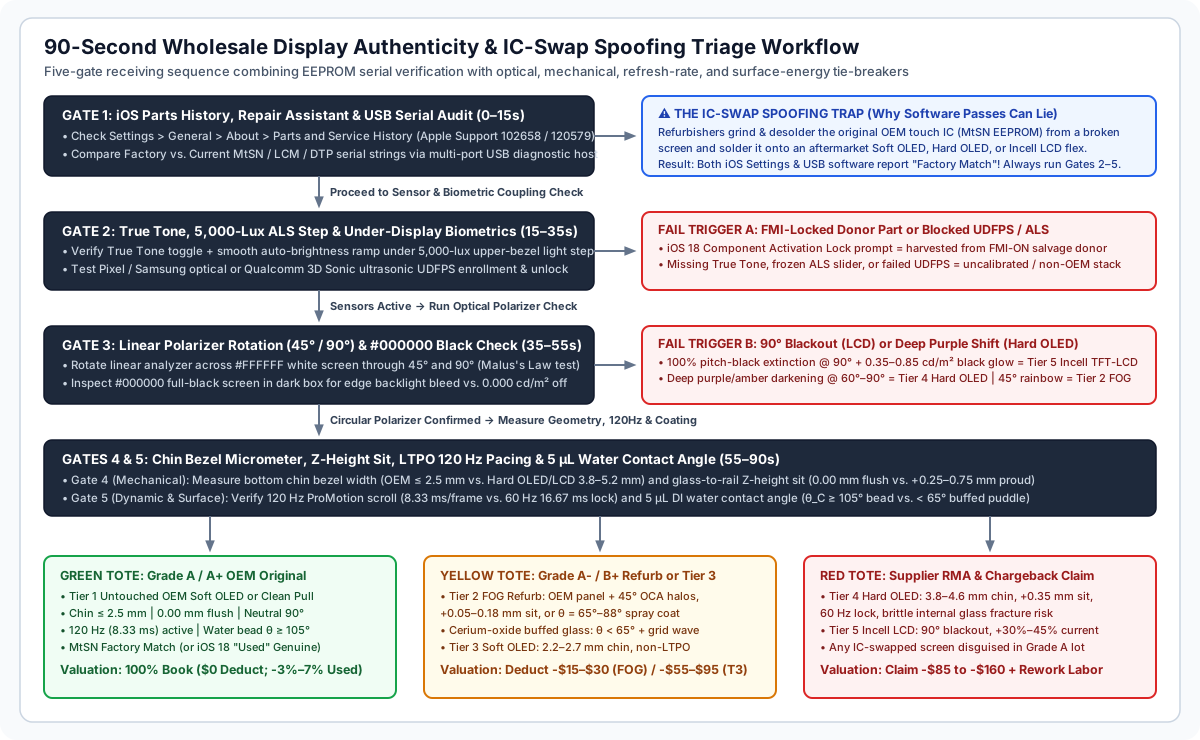
Because wholesale buyers routinely reject iPhones showing "Unknown Part" banners, secondary refurbishment factories execute Touch IC Transplanting (“IC Swaps”) on iPhone 11 through 16 series handsets:
- The technician takes the shattered original OEM display that came off the phone and uses a CNC micro-grinder or hot-air station to extract the tiny encrypted Touch Controller IC (
MtSNEEPROM chip) from the broken flex cable. - That original OEM chip is soldered onto the flex cable of a
$22Incell LCD, a$35Aftermarket Hard OLED, or a$55Aftermarket Soft OLED (often via a thin adapter tag flex). - When the phone boots, the logic board queries the display bus, reads its own original
MtSNcryptographic signature, and reports zero warning inSettings > General > Aboutand100% Factory Matchin USB diagnostic software.
Receiving inspectors catch IC-swapped counterfeit screens in seconds without opening the phone by running three cross-checks:
- True Tone &
5,000-LuxAmbient Light Sensor (ALS) Step Response: Even when an IC swap restores the True Tone toggle in Control Center (or when a programmer copiesMtSNdata onto an unencrypted iPhone X/XS/11 screen), aftermarket glass and panel apertures frequently misalign with the upper bezel ambient light sensor. Shine a5,000-luxinspection LED directly at the upper sensor notch while watching the Control Center brightness slider and executing our proximity and ambient light sensor calibration routines: an OEM screen ramps brightness smoothly within1.5 seconds, whereas an uncalibrated aftermarket stack stutters, freezes, or shifts white balance toward green/pink. - Android & iPhone Biometric Optical/Ultrasonic Coupling (
UDFPS&TrueDepth): On Google Pixel 6 through 10 series (Google Pixel Help 14257407) and Samsung Galaxy S21 through S25 series (Samsung Support ANS10001613), under-display fingerprint sensors (UDFPS) rely on precise OLED subpixel light transmittance (optical) or acoustic impedance through a flexible polyimide substrate (Qualcomm 3D Sonic ultrasonic). Installing a rigid Hard OLED, thick cold-pressed OCA glue layer, or backlit LCD attenuates the ultrasonic echo or distorts the optical collimator—causing fingerprint enrollment and unlock to fail during Face ID and ultrasonic fingerprint sensor tests. - Physical Optical & Mechanical Tie-Breakers (
Steps 1–4Above): Soldering an OEMMtSNchip onto an aftermarket flex cable only spoofs the digital serial string; it can never convert linear polarization into circular polarization (90°blackout check), shrink a4.2 mmHard OLED bottom chin down to2.1 mm, or give a60 Hzpanel8.33 msLTPO frame pacing.
| Refurbisher Modification Scenario | iOS Settings > General > About Readout |
USB Host Factory vs. Current (MtSN / LCM) |
True Tone & 5,000-Lux ALS Step Response |
Definitive Non-Invasive Tie-Breaker Test |
|---|---|---|---|---|
1. Untouched Factory Original Display (Tier 1) |
No replacement entry shown (Clean) | Factory == Current (100% Match) |
Active True Tone + smooth 1.5s ALS ramp |
Passes 90° neutral polarizer, 2.0–2.5 mm chin, 0.00 mm sit, 120 Hz, and θ_C ≥ 105° |
2. Clean FMI-OFF OEM Pull Calibrated via iOS 18 (Tier 1) |
Shows Used (Genuine Apple Part history) |
Factory ≠ Current (Paired via Repair Assistant) |
Active True Tone + restored ALS & 120 Hz |
Passes all Tier 1 physical checks; price within 3%–7% of untouched Grade A |
3. FMI-ON Salvage OEM Pull (iOS 18 Component Lock) |
Unknown / Calibration Blocked (Apple Account prompt) |
Factory ≠ Current (Donor serial locked) |
True Tone disabled; auto-brightness erratic | Immediate RMA Reject: donor screen is bound to an iCloud-locked salvage carcass |
4. Tier 2 FOG Cold-Pressed Glass (Original OEM Panel + IC) |
No replacement entry shown (Clean) | Factory == Current (Original MtSN intact) |
Active True Tone + normal ALS response | 45° polarizer shows rainbow OCA stress halos; +0.05–0.18 mm sit; water bead θ_C = 65°–88° |
5. IC-Swapped Tier 3 Aftermarket Soft OLED (MtSN Transplant) |
No replacement entry shown (Spoofed Clean!) | Factory == Current (Spoofed Match!) |
True Tone toggle present, but off-axis tint & ALS step lag | Peak brightness caps at 650–850 nits; lacks 1–10 Hz LTPO step-down; chin 2.2–2.7 mm |
6. IC-Swapped Tier 4 Hard OLED or Tier 5 Incell LCD (Fraud) |
No replacement entry shown (Spoofed Clean!) | Factory == Current (Spoofed Match!) |
Erratic ALS curve; blocks Android optical/ultrasonic UDFPS | Instant Catch: 90° blackout (LCD) or purple shift (Hard OLED) + 3.8–5.2 mm thick bottom chin + 60 Hz lock |
Takeaway: Compare serial-number reports with repair history and physical inspection. A matching identifier is one piece of evidence; resolve conflicting observations before accepting a handset as original-display stock.
Wholesale Grading Rubrics, Price Deductions, and Supplier RMA Chargeback Math
Translate bench test findings directly into commercial purchase order clauses and supplier RMA claims so disguised screens never erode your gross margin on bulk used phones.
Under the SERI R2v3 Standard (Appendix C Test and Repair & R2 Equipment Categorization REC), certified wholesale processors must evaluate Cosmetic Condition (C3–C6) independently from Functional and Component Readiness (F3–F5). A handset whose outer cover glass is 100% scratch-free (C5 / C6) but whose display stack is an uncalibrated aftermarket Hard OLED or Incell LCD fails OEM hardware equivalence and cannot be invoiced as “Grade A / A+ OEM Original.”
1. Standardize Display Provenance Clauses on Wholesale Purchase Orders
Write four explicit display acceptance rules into every wholesale purchase order and supplier grading rubric (cross-referenced with how graded used phones are described):
- Grade A / A+ (
100% OEM Original): Must carry an untouched Tier 1 Genuine OEM Soft OLED withFactory == CurrentMtSNpairing,0.00 mmflush frame sit,2.0–2.5 mm(1.15–1.55 mmBRS) symmetric bottom chin,120 HzLTPO scaling (on supported Pro/Ultra models), and an intact PVD oleophobic coating (θ_C ≥ 105°). - Grade A- / B+ (
Calibrated OEM Pull / Clean Tier 2 FOG Refurb): PermitsiOS 18Repair AssistantUsedcalibrated OEM pulls (-$10 to -$25delta) or bubble-free Tier 2 FOG Cold-Pressed Refurbished Glass on a genuine OEM Soft OLED panel (-$15 to -$30/unitwholesale discount), provided reglassing orUsedstatus is disclosed on the manifest. - Aftermarket Display Functional (
Disclosed Tier 3 Soft OLED): Must be segregated into an explicitAftermarket Screen / C-Grade FunctionalSKU at a-$55 to -$95/unitdiscount below OEM Grade A book value. - Zero-Tolerance RMA Rejects (
Tier 4 Hard OLED,Tier 5 Incell LCD,FMI-ONLocked Parts, & Undisclosed Buffed Glass): Automatically quarantined into the Red Tote for full supplier return or replacement-cost chargeback.
2. Supplier RMA Chargeback Formula and Worked 200-Unit Lot Audit
When a secondary broker delivers a lot of bulk used phones containing undisclosed aftermarket or reglassed displays, calculate the exact dollar chargeback (Claim_Recovery) by summing the OEM screen restoration cost (ΔV_oem_pull) and L2 bench rework labor (C_rework_labor) across each non-conforming tier, and bind every exception to a frozen intake export via serial number and IMEI reconciliation audits:
Claim_Recovery = Σ [ N_tier_i × (ΔV_oem_pull_i + C_rework_labor_i) ]
Consider a wholesale buyer receiving a 200-unit lot of “Grade A 100% Original iPhone 14 Pro (128GB)” invoiced at $460/unit ($92,000 total invoice). On automated USB software alone, 196 of the 200 units report Factory == Current MtSN serial match because the supplier used IC-swapped screens. However, executing the 90-Second Bench Inspection Protocol across all 200 handsets uncovers 41 disguised display exceptions within the 5-day RMA claim window:
Inspection Outcome Tier (200-Unit iPhone 14 Pro Lot) |
Unit Count (N_tier) |
USB Software Readout vs. 90-Second Physical Bench Finding | Per-Unit Deduction / Restoration Cost (ΔV + Labor) |
Total Supplier RMA Chargeback (USD) |
|---|---|---|---|---|
| 1. Verified Tier 1 Genuine OEM Original | 159 units (79.5%) |
MtSN Match + Neutral 90° polarizer + 2.15 mm chin + 120 Hz (8.33 ms) + θ_C = 112° |
$0.00 / unit (Accepted into Green Tote as Grade A) | $0.00 |
2. Disguised Tier 4 Aftermarket Hard OLED (IC-Swapped) |
14 units (7.0%) |
MtSN Spoofed Match, but 4.15 mm thick chin, +0.35 mm proud sit, 60 Hz lock, purple 90° tint |
$145.00 / unit ($125 clean FMI-OFF OEM pull + $20 L2 install & Repair Assistant) |
$2,030.00 |
3. Disguised Tier 5 Incell TFT-LCD (IC-Swapped) |
8 units (4.0%) |
4 Unknown + 4 Spoofed Match; 100% blackout at 90°, 4.65 mm chin, +0.55 mm step, +6.2°C heat |
$145.00 / unit ($125 OEM pull + $20 L2 install & display rail current audit) |
$1,160.00 |
| 4. Undisclosed Tier 2 FOG Refurb & Cerium-Buffed Glass | 19 units (9.5%) |
11 show 45° rainbow OCA stress rings (θ_C = 76°); 8 show flat water puddle (θ_C = 42°) + warped grid reflection |
$39.21 / unit avg (11 × $35 FOG downgrade + 8 × $45 buffed glass deduction) |
$745.00 |
Lot Audit Totals (41 Disguised Screens Caught) |
200 units (100%) |
USB software alone missed 37 of 41 swapped/modified screens (90.2% software false-pass rate) |
$95.98 avg claim across 41 non-conforming units | $3,935.00 Recovered |
Without the 90-second optical and mechanical bench gates, 37 IC-swapped and reglassed/buffed units would have slipped directly into Grade A resale stock—costing the buyer $3,935.00 in hidden overpayment plus any later costs arising from undisclosed component substitutions.
3. Copyable Per-IMEI Display Authenticity & RMA Evidence Log Template
Attach this structured evidence record to every Red Tote and Yellow Tote unit so supplier chargebacks and escrow disputes are backed by objective, reproducible physical measurements:
| Inspection Field | Recorded Measurement / Observation | Pass / Downgrade / RMA Threshold | Supplier RMA Evidence Artifact |
|---|---|---|---|
| 1. Handset Identity & Invoice Line | IMEI 1: ___ | Serial: ___ | Model/OS: ___ | PO & Carton #: ___ | Invoiced Grade: ___ |
Must match frozen IMEI reconciliation audit | Barcode scan log + unboxing video timestamp |
| 2. EEPROM Serial & iOS Parts Status | iOS About: [Clean / Genuine / Used / Unknown] | USB Factory MtSN: ___ vs. Current MtSN: ___ |
Unknown or FMI-ON lock = Reject; Factory == Current still requires Steps 3–6 |
Exported USB diagnostic JSON/PDF report |
3. Polarizer (45° / 90°) & #000000 Black |
45°: [Neutral / Rainbow Halos] | 90°: [Neutral / Purple / 100% Blackout] | #000000: [0.000 cd/m² / Bleed] |
90° Blackout = Tier 5 LCD (RMA); 90° Purple = Tier 4 Hard OLED (RMA); 45° Rainbow = Tier 2 FOG |
Side-by-side macro photo through 45° & 90° analyzer filter |
| 4. Bottom Chin & Z-Height Caliper | Bottom Chin: ___ mm (vs. Side: ___ mm) | Z-Height Rail Step: +___ mm |
Chin > 2.7 mm or Step > +0.20 mm on flagship OLED = Hard OLED / LCD Reject |
Macro photo of digital caliper jaws on illuminated bottom chin |
5. ProMotion 120 Hz & Biometrics |
Refresh: [120 Hz 8.33 ms / Locked 60 Hz 16.67 ms] | ALS Step: [Pass/Fail] | UDFPS/Face ID: [Pass/Fail] |
60 Hz lock on Pro/Ultra model or failed optical/ultrasonic UDFPS = RMA Reject |
Slow-motion 240 fps scroll clip or diagnostic sensor fail code |
6. 5 µL Water Contact Angle & Grid |
Droplet Profile: [Bead ≥ 105° / Dome 65°–88° / Flat Puddle < 65°] | 15° Grid Reflection: [Straight / Warped] |
θ_C < 65° + warped grid = CNC cerium-oxide buffed glass (Downgrade / Claim) |
Side-profile macro photo of 5 µL droplet + grazing grid reflection |
| 7. Final Tier & Dollar Claim | Assigned Tier: [Tier 1–5] | Tote: [Green / Yellow / Red] | Claim Amount: $___ | Inspector: ___ |
Submit within 2-to-5 business day supplier RMA window | Bundled per-IMEI claim packet sent to vendor trade desk |
Takeaway: Retain diagnostic logs and clear photographs for disputed units, and use the purchase agreement’s component and functional criteria to resolve the claim.
Frequently asked questions
How do I detect an aftermarket screen on a used phone when Settings shows no Unknown Part warning?
Refurbishers routinely grind or desolder the original touch controller IC (MtSN EEPROM) from a shattered OEM display and solder it onto an aftermarket Soft OLED, Hard OLED, or Incell LCD flex cable so iOS Settings > General > About shows no warning. Catch IC-swapped screens without opening the phone by rotating a linear polarizer filter to 90° (Incell LCDs black out completely; Hard OLEDs shift deep purple/amber), measuring the bottom chin bezel with a caliper (Hard OLEDs and LCDs are 1.2 mm to 2.0 mm thicker than the 2.0–2.5 mm OEM chin), checking True Tone and ambient light sensor responsiveness, and testing 120 Hz ProMotion scroll frame pacing.
What is the difference between an OEM pull screen, refurbished glass (FOG), and an aftermarket Soft or Hard OLED?
An OEM pull is a 100% factory-original flexible polyimide AMOLED assembly (panel, touch IC, and factory Ceramic Shield or Gorilla Glass) harvested intact from a donor phone. A refurbished glass (FOG) screen retains the genuine OEM flexible AMOLED panel and original touch IC but replaces scratched or cracked outer glass via -150°C cryogenic separation and cold-pressed optically clear adhesive (OCA) vacuum lamination. An aftermarket Soft OLED uses a third-party flexible polyimide panel that matches OEM bezel dimensions, while an aftermarket Hard OLED uses a rigid glass substrate that requires a thicker bottom chin bezel and cracks easily under minor point impacts.
Why do aftermarket Incell LCD screens damage iPhones and flagship Android phones designed for OLED?
OLED handsets power individual organic subpixels directly without a backlight, pulling zero current on pure #000000 black pixels. An aftermarket Incell TFT-LCD requires a constant LED edge backlight and crossed linear polarizers, which increases display current draw by 30% to 45% (180–320 mA extra load), raises chassis temperature by 4.5°C to 8.0°C, adds +0.45 mm to +0.75 mm of Z-height protrusion that presses against internal battery cells, blocks optical and ultrasonic under-display fingerprint sensors, and can burn out the logic board's display power management filters.
How does the polarized sunglasses test distinguish OEM OLED, Refurbished Glass, Hard OLED, and LCD screens?
Genuine Apple and Samsung OEM OLED assemblies use a circular polarizer (linear polarizer laminated to a quarter-wave retardation film) that emits circularly polarized light, maintaining uniform neutral brightness across a full 360° rotation through a linear analyzer. An aftermarket Incell LCD emits linearly polarized light that obeys Malus's Law, turning 100% pitch black at a 90° rotation angle. Cold-pressed OCA refurbished glass displays no 90° blackout but reveals rainbow photoelastic birefringence halos at 45° where lamination pressure was uneven, while low-grade Hard OLEDs exhibit severe purple or amber darkening between 60° and 90°.
How does iOS 18 Repair Assistant change OEM vs aftermarket display grading in bulk used phones?
On iPhone 12 and later running iOS 18, Apple's on-device Repair Assistant calibrates genuine OEM displays harvested from clean (FMI-OFF) donor iPhones and labels them as 'Used' in Settings > General > About > Parts and Service History, restoring True Tone and ProMotion 120 Hz scaling. However, if a donor screen was pulled from an Activation Locked (FMI-ON) salvage iPhone, iOS 18 Component Activation Lock blocks calibration and prompts for the donor owner's Apple Account credentials. Wholesale buyers should price 'Used' calibrated OEM pulls within 3%–7% of untouched Grade A stock, while rejecting FMI-locked or uncalibrated 'Unknown' screens.
How can receiving inspectors tell if a Grade A phone screen was mechanically buffed with cerium oxide?
Wholesale polishers use CNC cerium-oxide buffing wheels to grind 20 to 40 micrometers of glass off scratched Grade B/C screens so they pass naked-eye lightbox checks as Grade A. Because abrasive polishing strips the factory physical vapor deposition (PVD) fluoropolymer oleophobic coating, place a 5-microliter deionized water droplet on the center of the glass: intact OEM glass maintains a spherical bead with a contact angle of 105° to 115°, whereas buffed and un-recoated glass wets flat into a puddle below 65° and shows faint distortion waves under a low-angle grid reflection.
Sources
- About genuine iPhone displays - Apple Support (103256) — Apple Support Accessed October 25, 2026.
- iPhone Parts and Service History - Apple Support (102658) — Apple Support Accessed October 25, 2026.
- Use Repair Assistant to finish an iPhone or iPad repair - Apple Support (120579) — Apple Support Accessed October 25, 2026.
- How to clean your iPhone (Oleophobic Coating Guidelines) - Apple Support (108765) — Apple Support Accessed October 25, 2026.
- Apple Diagnostics for Self Service Repair - Apple Support (101965) — Apple Support Accessed October 25, 2026.
- If the screen isn't working on your iPhone or iPad - Apple Support (102567) — Apple Support Accessed October 25, 2026.
- Optimizing iPhone and iPad apps to support ProMotion displays — Apple Developer Documentation Accessed October 25, 2026.
- R2v3 Standard (Appendix C Test and Repair & REC Categorization) — Sustainable Electronics Recycling International (SERI) Accessed October 25, 2026.
- Repair your own Pixel device (Display & Fingerprint Calibration) — Google Pixel Phone Help Accessed October 25, 2026.
- Use the fingerprint sensor on your Galaxy phone or tablet (ANS10001613) — Samsung Support Accessed October 25, 2026.