Direct answer
Cell phone liquidation pallets split into three streams: R2v3-evaluated carrier trade-ins (82%–92% resale yield), untested customer returns (35%–50% clean functional yield after 20%–30% lock fallout), and salvage/BER lots (0%–8% whole-unit yield). Because iOS 18 extends Activation Lock to serialized screens, batteries, and cameras pulled from FMI-ON donors, buyers must deduct lock write-offs, L2 swap labor, NIST sanitization, DDR battery hazmat costs, and auction fees before bidding.
Key takeaways
- Never bid on untested customer returns or salvage manifests using graded carrier trade-in wholesale prices; untested return lots average 35%–50% direct functional yield.
- Separate SERI R2v3 evaluated functional grades (REC C3–C6 / F3–F4) from raw 'As-Is / Uninspected' retail return manifests before calculating expected recovery.
- Under iOS 18 (Apple Support 102658), serialized displays, batteries, and cameras harvested from Activation Locked (FMI-ON) donor iPhones trigger calibration locks on recipient devices.
- 2-into-1 board swaps require a clean FMI-OFF logic board transferred with its cryptographically paired biometric sensor into an FMI-OFF donor housing.
- Budget a 30-to-60-day reserve for delayed GSMA lost/stolen insurance blacklists and carrier Equipment Installment Plan (EIP) non-payment holds under 47 CFR § 27.16 exceptions.
- Dead-NAND salvage boards that cannot verify NIST SP 800-88 Cryptographic Erase (Purge) require physical destruction, and swollen batteries require 49 CFR § 173.185(f) ground-only packaging.
Bidding on cell phone liquidation pallets using nominal retail manifest values wastes working capital and causes costly rework when cloud locks, unpaid carrier installment plans, and serialized component blocks brick half the lot. Wholesale buyers and repair operations must price untested customer returns and salvage manifests by modeling net functional yield, L2 board-swap labor, data sanitization overhead, and auction buyer premiums before placing a bid.
Across B-Stock carrier portals, direct MVNO auctions, and big-box reverse-logistics liquidators, electronic liquidation pallets arrive through three fundamentally different supply streams. Treating an uninspected retail return manifest or an insurance salvage lot like pre-screened wholesale inventory destroys margin before the pallet reaches the unloading dock. Use our wholesale phone sourcing and grading guides alongside this valuation framework to audit manifest columns, lock exposure, and harvestable part value across every lot tier.
| Pallet stream & manifest label | SERI R2v3 / REC baseline | Clean functional yield (F3/F4) |
Cloud, Knox & EIP lock fallout | Board-swap & part harvest viability | Typical max bid (% of clean wholesale book) |
|---|---|---|---|---|---|
Graded Carrier Trade-In (R2v3 Evaluated / Grade A–C) |
Evaluated under SERI R2v3 Appendix C (REC C3–C6 / F3–F4); NIST Purge verified |
82%–92% ready for immediate wholesale resale | 2%–5% (delayed post-trade billing or blacklist dispute) | High on minor fallout (5%–10% need battery or back-glass service) |
68%–76% of clean B-grade wholesale value |
Untested Customer Returns (Raw Retail / 14–30 Day Open-Box) |
Uninspected raw stream; cannot be sold as R2v3 F3/F4 until triaged |
35%–50% clean working after wipe and SIM/CSC check | 20%–30% bricked by FMI, Knox Guard, or unpaid carrier EIP | Moderate (15%–25% repairable; FMI-OFF dead units feed board swaps) |
38%–45% of clean B-grade wholesale value |
Salvage / Insurance BER (Scrap / Parts-Only / Smash & Liquid) |
Unsanitized raw stream; high R2v3 Appendix B destruction exposure |
0%–8% intact functional recovery without major rebuild | 35%–55% FMI-ON (iOS 18 blocks serialized screen/camera pulls) |
25%–40% viable for FMI-OFF 2-into-1 board swaps or mechanical pulls | 10%–16% of clean B-grade wholesale value |
Separate the Three Liquidation Pallet Streams Before You Read the Manifest
Classify every auction manifest into one of the three upstream reverse-logistics channels before calculating unit values, because functional yield and lock fallout depend on where the handsets exited the retail lifecycle. When reviewing how to read a wholesale phone lot row by row, the manifest header often advertises an aggregate “Extended Retail Value” based on original MSRP—a figure that has zero relationship to secondary market recovery.
1. Graded Carrier Trade-In Pallets (R2v3 Evaluated)
Tier-1 carrier trade-in lots processed through facilities certified under the SERI R2v3 Standard (Appendix B Data Sanitization & Appendix C Test and Repair) undergo automated triage before palletization. Under the R2 Equipment Categorization (REC) framework, these handsets carry explicit cosmetic codes (C3 through C6) paired with verified functional designations such as F3 (Key Functions Working) or F4 (Hardware Functional). Because trade-in credit requires the consumer to disable Find My (FMI) and pass automated software diagnostics, direct wholesale yield reaches 82% to 92%, with 5% to 10% requiring routine cycle-count battery replacement or cosmetic glass service. For grade mapping across supplier sheets, compare the manifest rubric against how graded used phones are described.
2. Big-Box and Carrier “Untested Customer Returns”
Electronic liquidation pallets labeled “Untested Customer Returns,” “Raw Buyer’s Remorse,” or “Shelf Pull / Open-Box” originate from 14-to-30-day retail return windows at big-box stores, e-commerce marketplaces, and carrier dealer networks. In practice, raw customer returns suffer from three structural distortions:
- Active User Locks Left on Returned Stock: Retail return counter clerks rarely verify that a customer signed out of their Apple Account, Google Factory Reset Protection (
FRP), or Samsung account before issuing a refund, leaving 20% to 30% of untested return pallets locked at activation. - Intermittent Hardware Faults Disguised as Remorse: Customers frequently claim “changed mind” to avoid restocking fees when returning handsets with intermittent baseband dropouts, failing ultrasonic fingerprint sensors, or liquid contact indicators (
LCI) tripped inside the SIM slot. - Middleman Pre-Sorting (“Cherry-Picking”): Secondary brokers who buy full truckloads from primary liquidators often scan the outer box IMEIs, pull the clean high-margin flagship units, and re-palletize the locked and defective remainders as “uninspected liquidation pallets.”
3. Salvage, Insurance Claim, and BER Pallets
Salvage and Beyond Economic Repair (BER) lots aggregate insurance deductible replacements, depot repair rejects, display-crush casualties, and liquid-damaged units. Fewer than 8% of units on a true salvage pallet boot into a sellable handset without major component replacement. Profitability on salvage lots depends entirely on whether your bench can execute 2-into-1 board swaps and harvest clean OEM sub-assemblies without colliding with hardware serialization locks.
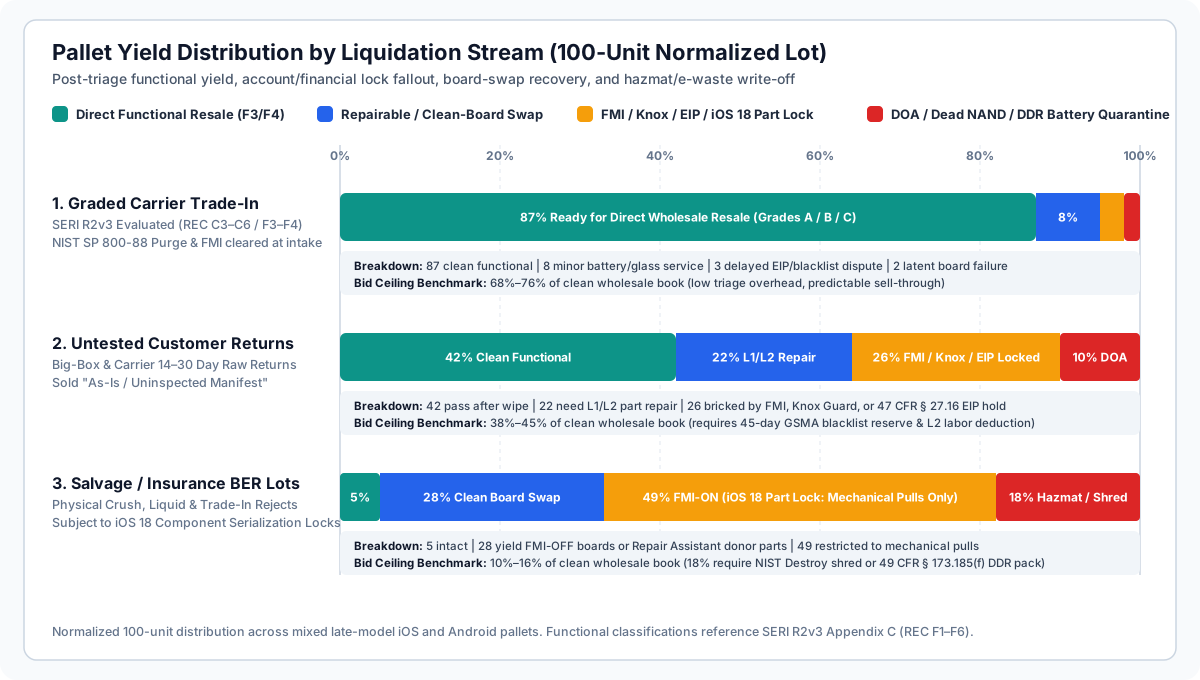
Takeaway: Never apply a single defect discount across auction categories; verify whether the seller is an R2v3-certified primary trade-in processor or a secondary broker reselling unsorted customer returns.
Account Locks, Carrier EIP Balances, and Delayed Blacklists Eat Untested Yield
Deduct 20% to 30% from the gross unit count of any untested customer return pallet to account for four distinct digital lock layers that turn physically pristine handsets into parts carcasses or export-only stock. A clean outer box and flawless OLED glass mean nothing if the logic board cannot activate on a cellular network.
- Apple Activation Lock and Enterprise MDM Supervision: Under Apple Support 108794 on Activation Lock for iPhone and iPad, enabling Find My automatically links the device’s hardware identifiers to the owner’s Apple Account on Apple’s activation servers. Performing a DFU restore wipes user media but leaves the handset bricked at the
"iPhone Locked to Owner"screen. Similarly, corporate returns enrolled in Automated Device Enrollment (Apple Business ManagerMDM) re-enforce remote management locks immediately upon Wi-Fi activation. - Samsung Knox Guard and Tripped Warranty Bits: On late-model Galaxy S and Z-series returns, enterprise or carrier finance enrollment activates
Knox Guardat the bootloader level, locking the screen as soon as the device connects to a network. Buyers must run Samsung Knox Guard and warranty-bit verification in Download Mode to confirmKG STATUS: CHECKING / COMPLETEDandWARRANTY VOID: 0x0before grading a unit as functional. - Unpaid Carrier Equipment Installment Plans (
EIP): Even when a handset is free of cloud locks, carrier financial holds prevent domestic activation. While FCC 47 CFR § 27.16 network access regulations establish open-platform access rules prohibiting licensees from locking devices once service obligations are met, carriers lawfully maintain non-payment restrictions and refuse SIM unlocking when an installment contract defaults or suffers a credit chargeback. - Delayed GSMA Blacklist Flipping (The 45-Day Window): Querying the GSMA Device Check registry on auction day only confirms whether an operator has flagged the IMEI as lost or stolen at that moment. In untested return lots, fraudulent buyers frequently return an empty box or a swapped housing—or file an insurance claim weeks after abandoning a financed line—causing an IMEI that scanned
Cleanat intake to flip toBlacklisted30 to 60 days later. Enforce separate IMEI blacklist and financial lock screening records at intake and again before wholesale release.
| Lock or restriction layer | Verification method at intake | Impact on domestic resale value | Salvage / recovery path |
|---|---|---|---|
Find My (FMI ON) / Activation Lock |
Pre-setup "Hello" screen check or USB host query (Apple Support 108794) |
−92% to −96% (unsellable as whole handset; iOS 18 locks serialized parts) |
Unpaired mechanical pulls only ($8–$18 frame, Taptic, speaker) |
| Enterprise MDM Supervision | Automated Device Enrollment check during Wi-Fi setup | −75% to −85% (cannot bypass remote management profile) | Harvest screen/camera if FMI OFF (Repair Assistant eligible) |
Samsung Knox Guard (KG ACTIVE) |
Download Mode header (KG STATUS) & settings check |
−80% to −90% (bootloader finance lock bricks domestic UI) | Harvest unserialized OLED frame assembly and camera modules |
| Unpaid Carrier EIP / Financed Hold | Carrier-specific financial check alongside 47 CFR § 27.16 unlock status |
−35% to −55% (blocked on issuing carrier; cannot SIM-unlock) | MVNO or out-of-region export only with explicit buyer disclosure |
| GSMA Lost / Stolen Block List | Authorized GSMA Device Check query + 45-day hold re-check | −85% to −95% (barred from cellular network attachment) | Disassemble for FMI-OFF sub-assemblies; shred unsanitized board |
Takeaway: Never treat an auction-day GSMA Clean badge as proof of clear title; price a 20%–30% combined cloud, Knox, and EIP lock write-off into every untested customer return bid.
How iOS 18 Component Activation Lock Changes Salvage & Board-Swap Math
Re-price all Apple salvage and BER pallets around component-level serialization, because iOS 18 eliminates the traditional refurbishment strategy of harvesting genuine OLED displays, batteries, and cameras from iCloud-locked (FMI-ON) donor iPhones.
Historically, L2/L3 repair shops purchased smashed or FMI-locked salvage pallets at steep discounts to execute 2-into-1 board swaps or build an internal bin of genuine OEM pulls. Under Apple Support 102658 on iPhone Parts and Service History, Apple introduced a dual-edged architectural change starting with iOS 18 on iPhone 12 and later:
- The Upside (
Repair Assistantfor Clean Donors): On iPhone 12 and later runningiOS 18, technicians can install a genuine used display, battery, rear camera, or TrueDepth camera pulled from a clean (FMI-OFF) donor iPhone of the same model and run on-device Repair Assistant without needing an Apple GSX cloud session. Once calibrated,Settings > General > About > Parts and Service Historylabels the component cleanly asUsedrather than flagging an"Unknown Part"warning. - The Salvage Blocker (
iOS 18Component Activation Lock): Simultaneously,iOS 18extends Activation Lock from the logic board to individual serialized sub-assemblies (displays, batteries, rear cameras, and TrueDepth cameras) linked to the donor iPhone’s Apple Account. When a technician harvests an OEM OLED screen or camera from anFMI-ONor Lost Mode salvage carcass and installs it into a clean customer handset runningiOS 18, the recipient phone detects the donor’s Activation Lock, demands the donor owner’s Apple Account password, and blocks calibration.
Mechanics of a Compliant 2-into-1 Board Swap
To turn two damaged salvage handsets into one high-grade functional unit without triggering serialization locks or losing biometric security, both donor units must pass strict pairing rules:
- Donor Unit 1 (The Identity Core): A handset with a crushed housing and shattered OLED screen, but a 100% functional, clean-IMEI,
FMI-OFFlogic board. Crucially, you must transfer the logic board together with its original cryptographically paired biometric sensor (or useiOS 18Repair Assistant to calibrate a clean TrueDepth camera on iPhone 12 and later; Touch ID home buttons on iPhone SE models and TrueDepth arrays on pre-iPhone 12 models remain permanently bound to the original Secure Enclave). Always verify post-swap biometrics using Face ID and ultrasonic fingerprint sensor testing. - Donor Unit 2 (The Chassis & Display Shell): A handset with a dead PMIC, shorted baseband, or unbootable logic board, an intact housing and genuine OLED display, and verified
FMI-OFFcloud status. Because the donor serial number has no Activation Lock on Apple’s servers, its OLED display, rear camera, and battery (verified via battery cycle count and capacity percentage analysis) will passRepair Assistantcalibration on Donor 1’s logic board.
What Remains Harvestable from FMI-ON Salvage Units
When a salvage iPhone tests FMI ON, strip only unserialized mechanical and passive components that carry no cryptographic MCU binding:
- Harvestable (
$8–$18total recovery per carcass): Aluminum or titanium mid-frame housing (provided no IMEI is engraved on iPhone 14 and later), SIM tray, Taptic Engine, bottom loudspeaker, upper earpiece speaker, wireless charging / MagSafe coil assembly, volume/power button flexes, Wi-Fi/Bluetooth antenna flexes, and internal cowlings/screws. - Locked / Unusable on iOS 18 Recipient Devices: Serialized OEM OLED display assembly, serialized BMS battery cell, rear camera array, TrueDepth camera module, and the FMI-locked logic board.
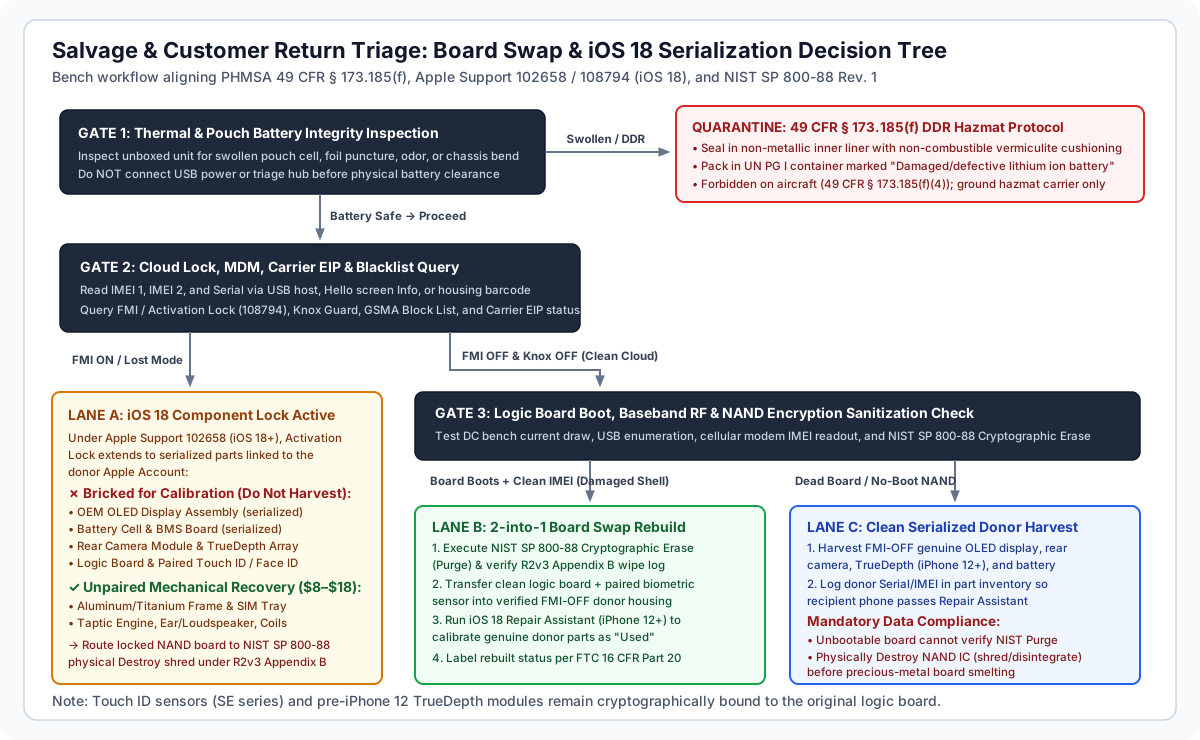
Rule of thumb — salvage donor valuation: If a salvage manifest does not prove FMI OFF status by serial number, value every Apple unit on the pallet at $12 in unpaired mechanical pulls rather than assuming you can harvest $90+ OLED screens and cameras.
Takeaway: Only FMI-OFF donor iPhones yield displays, batteries, and cameras that calibrate cleanly through iOS 18 Repair Assistant; FMI-ON salvage units must be priced strictly for unpaired mechanical housings, speakers, and Taptic engines.
Maximum Auction Bid Ceiling Formula and Worked 100-Unit Pallet Worksheet
Calculate your maximum auction hammer bid by working backward from post-triage realizable revenue and deducting bench labor, replacement parts, data sanitization, hazmat disposal, freight, target profit margin, and the liquidation platform’s buyer premium.
Use this deterministic bidding equation before entering an auction proxy bid:
Max Bid = [ (R_func + R_swap + R_parts) − (C_labor + C_parts + C_sanit_hazmat + C_freight + M_target) ] ÷ (1 + P_buyer)
Where each variable is defined as:
R_func: Gross wholesale revenue from immediately functional (F3/F4), clean-IMEI,FMI-OFF/Knox-OFFunits after cosmetic grading.R_swap: Gross revenue from rebuilt handsets completed via 2-into-1 Board Swaps or L1/L2 component repair.R_parts: Salvage value recovered from unpaired mechanical pulls ($8–$18/unit), verifiedFMI-OFFserialized donor assemblies, and R2v3 smelter scrap for depopulated circuit boards.C_labor: Total shop labor cost across unboxing tally, IMEI/FMI registry checks, automated diagnostics, and L2 board-swap bench time (Units × Minutes ÷ 60 × Hourly Shop Rate).C_parts: External replacement consumables purchased (e.g., new cycle-0 batteries, water-resistant frame adhesives, replacement displays).C_sanit_hazmat: Per-device software licenses forNIST SP 800-88cryptographic wipe logs, physical shred fees for dead-NAND boards, and49 CFR § 173.185(f)vermiculite/Packing Group I disposal for swollen batteries.C_freight: Inbound LTL pallet freight, liftgate delivery, and transit insurance.M_target: Minimum required net dollar profit margin on the lot (typically 15% to 20% of gross realizable revenue to buffer 45-day blacklist chargebacks).P_buyer: Liquidation marketplace buyer’s premium (typically 10% to 18% on B-Stock and commercial auction portals, expressed as a decimal such as0.125for12.5%).
Worked Example: 100-Unit Untested Customer Returns vs. 100-Unit Salvage Pallet
Consider two 100-unit mixed pallets of iPhone 13 (128GB) and Samsung Galaxy S22 (128GB) where the auction manifest lists an original MSRP “Extended Retail Value” of $62,000 ($620/unit), and the current secondary wholesale price for a clean, tested B-grade (REC C4/F3) handset is $285/unit ($28,500 if 100% of the lot were clean and working). Shop labor is billed at $45/hour ($0.75/minute), inbound LTL freight is $330, the auction buyer’s premium is 12.5% (P_buyer = 0.125), and the shop requires an 18% net margin on gross realizable revenue.
| Valuation line item | Stream A: 100-Unit Untested Customer Returns | Stream B: 100-Unit Salvage / BER Pallet | Engineering & statutory basis |
|---|---|---|---|
| Nominal Manifest MSRP | $62,000 ($620/unit illusion) | $62,000 ($620/unit illusion) | Irrelevant retail anchor; never use for bidding |
100% Clean Wholesale Book ($285/unit) |
$28,500 | $28,500 | Secondary market B-grade (C4/F3) benchmark |
1. Clean Functional Yield (R_func) |
42 units × $285 = $11,970 | 5 units × $285 = $1,425 | Pass wholesale phone intake diagnostics & NIST Purge |
2. Rebuilt / Board-Swap Yield (R_swap) |
22 units repaired × $285 = $6,270 | 14 rebuilt units (from 28 clean-cloud donors) × $265 = $3,710 | 2-into-1 clean-board swaps + Repair Assistant calibration |
3. Part Harvest & Scrap (R_parts) |
26 locked ($45 avg mixed pull) + 10 DOA ($99 total) = $2,160 | 49 FMI-ON ($12 mech pull) + 18 dead/scrap ($242) = $830 | iOS 18 restricts FMI-ON iPhones to unpaired mechanical parts |
Gross Realizable Revenue (R_total) |
$20,400 | $5,965 | Sum of R_func + R_swap + R_parts |
Less: Triage & L2 Bench Labor (C_labor) |
−$1,680 (100×12m triage + 22×40m repair + 160m strip @ $0.75/m) | −$1,140 (100×8m triage + 14×35m swap + 49×4.7m strip @ $0.75/m) | Includes water damage and latent corrosion testing |
Less: Replacement Parts (C_parts) |
−$1,420 (batteries, seals, 12 screens) | −$180 (14 waterproofing gaskets & cycle-0 adhesive kits) | Salvage swaps draw screens from FMI-OFF Lane C donors |
Less: Sanitization & DDR Hazmat (C_sanit_hazmat) |
−$450 ($150 wipe certs + 4 DDR batteries + 6 board shreds) | −$520 ($60 wipe certs + 14 DDR battery packs + 67 board shreds) | NIST SP 800-88 Destroy shred + 49 CFR § 173.185(f) DDR |
Less: Inbound LTL Freight (C_freight) |
−$330 (1 pallet LTL + liftgate) | −$330 (1 pallet LTL + liftgate) | Dock-to-dock palletized ground freight |
Less: Target Net Margin (M_target = 18%) |
−$3,672 (0.18 × $20,400) |
−$1,074 (0.18 × $5,965) |
Includes reserve for 45-day GSMA blacklist reversals |
Net Landed Cost Cap (Before Fee) |
$12,848 | $2,721 | Maximum total cash outlay including auction fees |
Less: 12.5% Buyer’s Premium (P_buyer) |
−$1,428 ($12,848 − ($12,848 ÷ 1.125)) |
−$302 ($2,721 − ($2,721 ÷ 1.125)) |
B-Stock / liquidation portal buyer fee (12.5%) |
Maximum Auction Hammer Bid (Max Bid) |
$11,420 ($114.20 / unit) | $2,419 ($24.19 / unit) | 40.1% (Returns) vs. 8.5% (Salvage) of clean wholesale book |
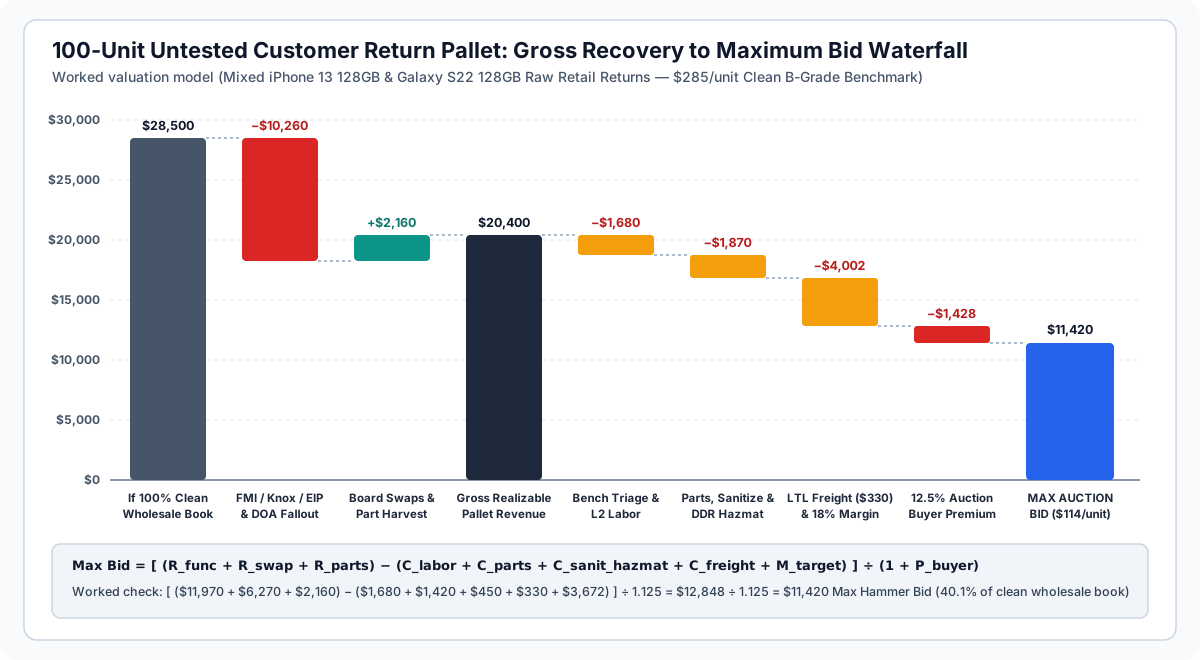
Takeaway: A 100-unit untested customer return pallet caps out near 40% of clean wholesale book value ($114.20/unit in the worked model), while an unverified salvage pallet of the same models caps below 9% of wholesale book ($24.19/unit) once iOS 18 component locks and hazmat disposal are deducted.
Receiving Tally, NIST SP 800-88 Data Sanitization, and DDR Battery Hazmat Rules
Protect your shop against regulatory penalties, lithium-ion thermal fires, and missed shortage claims by executing a locked dock-to-bench workflow the moment a liquidation pallet arrives.
1. Unboxing Tally and Serial Reconciliation Within the Claim Window
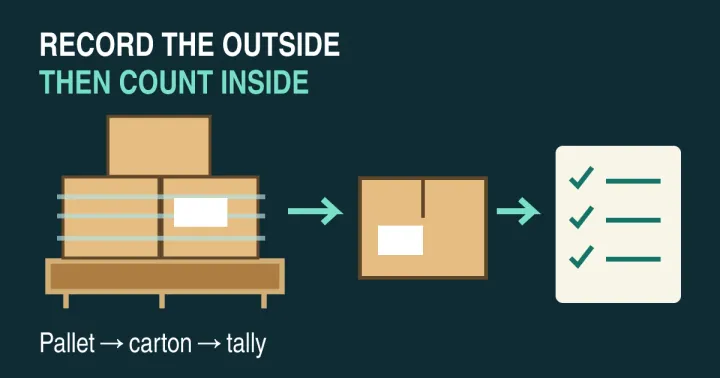
Most liquidation marketplaces enforce a strict 2-to-5 business day discrepancy window from the carrier delivery scan, and only pay claims when shortage or model-swap variances exceed a stated deductible (often 2% to 5% of manifest value). Follow palletized shipment unboxing and tally protocols to photograph stretch-wrap tamper seals, weigh each master carton on a calibrated scale before cutting tape, and log every handset into a frozen intake sheet using serial number and IMEI reconciliation audits. Catching dummy weights, empty retail boxes, or swapped SIM trays on video during unboxing is required to win a manifest misrepresentation dispute.
2. NIST SP 800-88 Rev. 1 Data Sanitization: Purge vs. Destroy
Customer return and salvage pallets routinely arrive with active consumer photos, banking tokens, and cached credentials stored on internal flash memory. Under NIST SP 800-88 Rev. 1 Guidelines for Media Sanitization and SERI R2v3 Appendix B, simple file deletion or unverified factory resets do not qualify for resale release:
- Booting Handsets (
Cryptographic Erase / Purge): Modern iPhones (Secure Enclave AES key hierarchy) and Android devices (File-Based Encryption / TrustZone) satisfy theNIST SP 800-88 Purgetier when a verified Cryptographic Erase destroys the media encryption key via DFU/recovery restore and generates a tamper-evident software sanitization certificate tied to the device’s IMEI and serial number. - No-Power / Dead-NAND Salvage Boards (
Destroy): When a salvage handset has a cracked PCB, dead PMIC, or failed NAND controller that prevents booting to execute Cryptographic Erase—and board-level repair is not performed to complete a verifiedPurge—bothNIST SP 800-88andR2v3 Core Requirement 7prohibit selling the intact logic board as scrap. You must physically Destroy the NAND storage IC (via mechanical shredding, disintegration, or chip milling) before sending the depopulated board to precious-metal refining.
3. FTC Reconditioned Disclosure (16 CFR Part 20)
When your bench rebuilds liquidation units via 2-into-1 board swaps or harvested sub-assemblies, FTC 16 CFR Part 20 rebuilt and reconditioned disclosure guides prohibit marketing repaired or returned goods as “New” or “New Open-Box.” Wholesale invoices and retail listings must clearly disclose Refurbished, Reconditioned, or Rebuilt status, and any iPhone calibrated via iOS 18 Repair Assistant will transparently display Used component provenance in Settings > General > About.
4. Swollen Battery Quarantine Under PHMSA 49 CFR § 173.185(f)
Salvage pallets and aged customer returns frequently contain lithium-ion pouch cells that have swollen, delaminated, or suffered mechanical crush. Under PHMSA 49 CFR § 173.185(f) damaged or defective lithium battery rules, these units are regulated as Damaged, Defective, or Recalled (DDR) hazardous materials:
- Immediate Bench Isolation: Never connect a swollen handset to a USB hub or multi-bay charging cart. Extract or isolate the unit onto a fireproof surface immediately.
- Compliant DDR Packaging: Place each DDR battery or handset individually inside a closed non-metallic inner liner, surround it with non-combustible, electrically non-conductive, and absorbent cushioning material (such as grade-verified vermiculite) inside a UN Packing Group I (
PG I) outer container (such as a4Gfiberboard box or1A2steel drum). - Marking and Ground-Only Transport: Mark the outer container clearly with
"Damaged/defective lithium ion battery". Under49 CFR § 173.185(f)(4), DDR lithium-ion batteries are strictly forbidden from transport aboard aircraft and must move exclusively via certified ground hazmat carriers.
Takeaway: Quarantine swollen DDR batteries into vermiculite-lined Packing Group I containers at unboxing, and physically shred any unbootable salvage NAND chip that cannot complete a verified NIST SP 800-88 Purge.
Frequently asked questions
What is a realistic functional yield on untested cell phone liquidation pallets?
On genuine uninspected big-box or carrier 14-to-30-day customer return pallets, expect 35% to 50% of units to pass diagnostic testing with clean IMEIs and cleared user accounts (F3/F4 functional). Another 20% to 30% typically fail due to Find My Activation Lock, Samsung Knox Guard, or unpaid carrier installment balances, while 15% to 25% require L1/L2 hardware repair and 5% to 10% represent dead boards, water damage, or return-box fraud.
Did iOS 18 stop refurbishers from harvesting screens and cameras from iCloud-locked salvage iPhones?
Yes, for serialized components on iPhone 12 and later running iOS 18. While Apple's Repair Assistant allows genuine used parts from clean FMI-OFF donors to calibrate and display as 'Used' in Parts and Service History, iOS 18 binds individual component serial numbers (OLED displays, batteries, rear cameras, and TrueDepth arrays) to the donor phone's Apple Account. If the donor unit has Find My enabled, harvested serialized parts prompt for the donor owner's credentials and refuse calibration.
Which parts can still be harvested from an FMI-locked iPhone on a salvage pallet?
Refurbishers can still harvest non-serialized mechanical and passive assemblies from FMI-ON salvage units, including the aluminum or titanium mid-frame housing, SIM tray, Taptic Engine, earpiece and loudspeaker modules, wireless charging coil, button flexes, and screw sets. These unpaired mechanical pulls typically recover $8 to $18 per carcass rather than the $65 to $140 historically recovered from a genuine OEM OLED assembly.
How do I calculate the maximum auction bid for an electronic liquidation pallet?
Sum expected gross recovery from clean functional units, completed 2-into-1 board swaps, and unpaired mechanical part pulls, then subtract intake triage and L2 repair labor, external replacement parts, NIST SP 800-88 sanitization and 49 CFR § 173.185(f) hazmat disposal costs, inbound LTL freight, and your target dollar profit margin. Divide that net landed cost cap by (1 + the marketplace buyer's premium percentage) to get your maximum hammer bid.
Why do phones that scan clean on GSMA Device Check at auction later turn blacklisted?
GSMA Device Check reflects operator blacklists at the exact timestamp of the query. On untested customer return and salvage pallets, original retail buyers or trade-in fraudsters frequently file lost or stolen insurance claims or default on carrier Equipment Installment Plans (EIP) 30 to 60 days after the retail return window, flipping a clean auction-day IMEI to blocked.
How must swollen lithium-ion batteries found in salvage phone pallets be shipped?
Under PHMSA 49 CFR § 173.185(f), any smartphone or pouch cell showing swelling, outgassing, or thermal/crush damage is classified as a Damaged, Defective, or Recalled (DDR) battery. Each unit must be individually sealed in non-metallic inner packaging, surrounded by non-combustible, electrically non-conductive absorbent cushioning such as vermiculite inside a UN Packing Group I outer container marked 'Damaged/defective lithium ion battery,' and shipped exclusively by ground transport.
Sources
- iPhone Parts and Service History - Apple Support (102658) — Apple Support Accessed October 25, 2026.
- Activation Lock for iPhone and iPad - Apple Support (108794) — Apple Support Accessed October 25, 2026.
- R2v3 Standard (Appendix B Data Sanitization & Appendix C Test and Repair) — Sustainable Electronics Recycling International (SERI) Accessed October 25, 2026.
- SP 800-88 Rev. 1, Guidelines for Media Sanitization — National Institute of Standards and Technology (NIST) Accessed October 25, 2026.
- Device Check - Global IMEI Database Registry — GSMA Accessed October 25, 2026.
- 47 CFR § 27.16 - Network access requirements for Block C — Federal Communications Commission (FCC) / eCFR Accessed October 25, 2026.
- 16 CFR Part 20 - Guides for Rebuilt, Reconditioned and Other Used Parts — Federal Trade Commission (FTC) / eCFR Accessed October 25, 2026.
- 49 CFR § 173.185 - Lithium cells and batteries — Pipeline and Hazardous Materials Safety Administration (PHMSA) / eCFR Accessed October 25, 2026.